Competitive Coding Reference
Source: https://leetcode.com/discuss/career/217868/My-notes-for-the-night-before-interview
Coding
Section titled “Coding”Basic things
Section titled “Basic things”MODULO
Section titled “MODULO”In Java we can write 10^9+7 as:
static final int MOD = (int)(1e9 + 7 );Where, 1e9 is a double representing scientific notation for the number one followed by nine zeros - 1,000,000,000.
When dealing with modulo questions, it’s better to use the self-implemented add method.
public int add(int a,int b){ return (a+b)%MOD;}When dealing with modulo questions involving multiplication, it’s better to use the long datatype, as long datatype can store (1e9+7)^2.
public int multiply(int a, int b) { return (int)( (a*(long)b)%MOD );}We need to be careful when dealing with modulo in case of subtraction, as the value can be negative.
public int subtract(int a,int b){ return ((a-b)%MOD + MOD)%MOD;}// (21 - 18)%10 = 3 let us suppose, MOD == 10// BUT, (21%10 - 18%10)%10 == (1 - 8)%10 = -7// both 3 and -7 are mathematically equal as, -7 + MOD == 3Modular division of a/b with MOD = p (p is a prime number):
(a/b)%p != (a%p / b%p)%p
For eg. if a = 10, b = 5, p = 5, then (a/b)%p = 2 and (a%p / b%p)%p = 0.
To find the correct value of (a/b)%p from (a%p / b%p)%p, we use Fermat’s theorem.
- Theorem 1: according to this
(a^p - a)is a multiple of p.k*p = (a^p - a)a^p % p = a % p
- Theorem 2: according to this
(a^(p-1) - 1)is an integer multiple of p, iff a is not a multiple of p.a^(p-1) % p = 1 % pa^(p-2) % p = a^(-1) % p(multiply both sides by a^(-1))modinv(a) = a^(-1) % p = a^(p-2) % p
So now (a%p / b%p)%p = (a%p * modinv(b)%p )%p = (a%p * b^(p-2)%p )%p
Modular exponentiation / power with mod
Section titled “Modular exponentiation / power with mod”static int power(int x, int y, int p){ int res = 1; // Initialize result
x = x % p; // Update x if it is more than or // equal to p
if (x == 0) return 0; // In case x is divisible by p;
while (y > 0) { // If y is odd, multiply x with result if ((y & 1) != 0) res = (res * x) % p;
// y must be even now y = y >> 1; // y = y/2 x = (x * x) % p; } return res;}ITERATING OVER MAP
Section titled “ITERATING OVER MAP”Iterating over maps, for pairs:
Map<String, Object> map = ... ; // just an examplefor (Map.Entry<String, Object> entry : map.entrySet()) { System.out.printf("%s -> %s\n", entry.getKey(), entry.getValue());}SINGLE LINE ARRAY RETURN
Section titled “SINGLE LINE ARRAY RETURN”Returning the array in a single line:
return new double[]{1.1,1.2};One-liner array sort:
Arrays.sort(times, (a,b) -> a-b);It allows insert and delete at both ends.
Deque<TreeNode> q = new ArrayDeque<>();Implementing classes: ArrayDeque, ConcurrentLinkedDeque, LinkedBlockingDeque, LinkedList.
Implementation to use: ArrayDeque, as if we need to add/remove at both ends, ArrayDeque is significantly better than a linked list. Also, random access to each element is O(1) for a cyclic queue.
The only better operation of a linked list is removing the current element during iteration. Also, LinkedList supports null elements, whereas ArrayDeque does not. LinkedList has methods like indexOf or remove(int) while ArrayDeque hasn’t.
It is a doubly ended linked list, and can be used as both a Stack and a Queue.
Stack method to equivalent Deque method:
| Stack Method | Equivalent Deque Method |
|---|---|
push(e) | addFirst(e) |
pop() | removeFirst() |
peek() | peekFirst() |
Queue method to equivalent Deque method:
| Queue Method | Equivalent Deque Method |
|---|---|
add(e) | addLast(e) |
offer(e) | offerLast(e) |
remove() | removeFirst() |
poll() | pollFirst() |
element() | getFirst() |
peek() | peekFirst() |
Deque methods summary:
| First Element (Head): Throws exception | First Element (Head): Special value | Last Element (Tail): Throws exception | Last Element (Tail): Special value | |
|---|---|---|---|---|
| Insert | addFirst(e) | offerFirst(e) | addLast(e) | offerLast(e) |
| Remove | removeFirst() | pollFirst() | removeLast() | pollLast() |
| Examine | getFirst() | peekFirst() | getLast() | peekLast() |
TreeMap and TreeSet
Section titled “TreeMap and TreeSet”No need to implement segment trees, as we can use these for range queries.
TreeMap stores the Map entries sorted by keys.
We can insert / search for an element in O(log n). We can get all keys belonging to a range using subMap.
SortedMap<K,V> subMap(K fromKey, K toKey): Returns a view of the portion of this map whose keys range fromfromKey, inclusive, totoKey, exclusive.Set<K> keySet(): Returns a Set view of the keys contained in this map.K firstKey(): Returns the first (lowest) key currently in this map.K lastKey(): Returns the last (highest) key currently in this map.K floorKey(K key): Returns the greatest key less than or equal to the given key, ornullif there is no such key.K lowerKey(K key): Returns the greatest key strictly less than the given key, ornullif there is no such key.K ceilingKey(K key): Returns the least key greater than or equal to the given key, ornullif there is no such key.K higherKey(K key): Returns the least key strictly greater than the given key, ornullif there is no such key.Map.Entry<K,V> pollFirstEntry(): Removes and returns a key-value mapping associated with the least key in this map, ornullif the map is empty.Map.Entry<K,V> pollLastEntry(): Removes and returns a key-value mapping associated with the greatest key in this map, ornullif the map is empty.
TreeSet<Long> bt = new TreeSet<>();// provides guaranteed log(n) time cost for the basic operations (add, remove, contains, floor, ceiling).new TreeSet<>( (a,b)->a-b );first(): Returns the first (lowest) element currently in this set.last(): Returns the last (highest) element currently in this set.pollFirst(): Retrieves and removes the first (lowest) element, or returnsnullif this set is empty.pollLast(): Retrieves and removes the last (highest) element, or returnsnullif this set is empty.bt.floor(): Returns the greatest element in this set less than or equal to the given element.bt.ceiling(): Returns the least element in this set greater than or equal to the given element.
Sliding window maximum
Section titled “Sliding window maximum”We need to know the maximum in the window of size k.
- Use max heap:
O(N log N) - Use
TreeMap:O(N log K) - Use deque:
O(N)
Using max heap:
// using max heappublic int[] maxSlidingWindow(int[] nums, int k) { int window[] = new int[nums.length-k+1], idx = 0; PriorityQueue<Integer> pq = new PriorityQueue<>(new Comparator<Integer>(){ @Override public int compare(Integer a,Integer b){ return nums[b]-nums[a]; } }); for(int i = 0 ; i < nums.length; i++){ if(i < k-1) { pq.add(i); continue; } while(!pq.isEmpty() && pq.peek() < i-k+1) pq.poll(); pq.add(i); window[idx++] = nums[pq.peek()]; } return window;}Using deque:
// using dequepublic int[] maxSlidingWindow(int[] nums, int k) { int window[] = new int[nums.length-k+1], idx = 0; Deque<Integer> dq = new ArrayDeque<>(); for(int i = 0 ; i < nums.length; i++){ // if my current element is greater than last element in dq while(!dq.isEmpty() && nums[dq.peekLast()] < nums[i]) dq.removeLast(); // if my first element in dq is out current window while(!dq.isEmpty() && dq.peekFirst() < i-k+1) dq.removeFirst(); dq.addLast(i); if(i < k-1) continue; window[idx++] = nums[dq.peekFirst()]; } return window;}Input Size and Time Complexity
Section titled “Input Size and Time Complexity”We can perform at most 10^8 to 10^9 operations. Most online judges use a 733 MHz CPU which can perform 7.33e8 operations in a second. The time limit is generally 1 to 2 seconds.
LAZY Increment
Section titled “LAZY Increment”Print modified array after multiple array range increment operations.
Example input and output:
int[] A = {3, 5, 4, 8, 6, 1};int[][] q = {{0, 3}, {4, 5}, {1, 4}, {0, 1}, {2, 5}};int increment = 2;output : [7, 11, 10, 14, 12, 5]public static String lazyIncrement(int[] A,int[][] queries,int increment) { int[] inc = new int[A.length]; for(int[] query: queries){ int i = query[0], j = query[1]; if(i!=0) inc[i-1] -= increment; inc[j] += increment; } // do reverse prefix sum for(int i = A.length-2; i >= 0; i--) inc[i] += inc[i+1]; for(int i = 0; i < A.length; i++) A[i] += inc[i]; return Arrays.toString(A);}2D ARRAY sorting
Section titled “2D ARRAY sorting”Sorting array of int:
// Sort arr in increasing order by their values.Arrays.sort(arr, Comparator.comparingInt(o -> o[0]));Sorting by value with original indices:
int n = nums.length;int[][] arr = new int[n][2];for (int i = 0; i < n; ++i) { arr[i][0] = nums[i]; arr[i][1] = i;}Arrays.sort(arr, Comparator.comparingInt(o -> o[0]));// Sort arr in increasing order by their values.HCF / GCD
Section titled “HCF / GCD”We want to find the HCF of two numbers A and B.
Property: since the HCF divides A and B, it also divides (A-B).
public static long gcd(long a,long b){ if(b==0) return a; if(a==0) return b; if(a>=b) return gcd(a-b,b); else return gcd(a,b-a);}We can optimise it further by using modulo:
public static long gcd(long a,long b){ if(b==0) return a; if(a==0) return b; if(a>=b) return gcd(a%b,b); else return gcd(a,b%a);}Without recursion:
private int gcd(int a, int b) { while (b != 0) { int temp = b; b = a % b; a = temp; } return a; }Handling updates in the priority queue
Section titled “Handling updates in the priority queue”The problem happens when we need to handle updating the key of a previously inserted value in a priority queue. One approach is to remove the element from the PQ and add it again.
An efficient approach is to keep a HashMap that tracks the most updated value associated with some key. The idea is to add all the <K,V> pairs to the priority queue, and whenever we want to make an update, also update the HashMap for that <K,V>. When it comes to reading values from the PQ (i.e. we want to poll the max or min), run a while loop to remove the outdated values (those keys whose values do not match the HashMap) from the PQ.
For eg. if we want to store Node<K,V> in the priority queue:
PQ -> [ Node<2,3> ]Map -> <2,3>
Adding more values (items are sorted based on their values)PQ -> [ Node<1,5>, Node<2,3>, Node<4,2> ]Map -> <2,3> <1,5> <4,2>
Now I want to update the value for key = 1 with value = 1, I will simply add it in pq and update the mapPQ -> [ Node<1,5>, Node<2,3>, Node<4,2>, Node<1,1>]Map -> <2,3> <1,1> <4,4>
Now if I want to read the max value item from the PQ, we run the while loop to check whether the max item has the updated value according to the Map, as per the following code:
// get the max valwhile(!pq.isEmpty()){ Node p = pq.peek(); if(map.get(p.key) == p.val){ // ok break; } else{ pq.poll(); }}Node mx = pq.peek();Inclusion - exclusion principle
Section titled “Inclusion - exclusion principle”
General inc - exc = sum of individual terms - (sum of even intersection) + (sum of odd intersection).
Prime Numbers
Section titled “Prime Numbers”
Inversions in an array: basically, inversions are the pairs that are in the wrong order relative to sorted order. For eg. in case of an ascending array A, if there is a pair (A_i, A_j) such that A[i] = A_i and A[j] = A_j, then if A_i > A_j and i < j, it forms an inversion pair. It is easily solved using a BIT.
Mod power exponentiation - compute a^b % m. Time complexity: O(log b).
Mod division - compute (a / b) % m.
To calculate this we find the modular multiplicative inverse (1 / b) % m => b^(-1) % m = y. The y is the multiplicative inverse of x such that x*y = 1. The multiplicative inverse may not exist; it only exists if gcd(x, m) = 1, as otherwise any x*y will be divisible by m because x gcd(x, m) != 1.
Segment tree
Section titled “Segment tree”Suffix array
Section titled “Suffix array”Dynamic programming and graphs
Section titled “Dynamic programming and graphs”- Digit DP, DP patterns and DP problems: see Dynamic Programming Reference.
- Graph representations, algorithms and graph problems: see Graph Algorithms Reference.
union-find algorithm
Section titled “union-find algorithm”It performs two useful operations:
- FIND: determine which subset a particular element is in.
- UNION: join the two subsets into a single subset.
public static void union(int u,int v, int[] ufds){ ufds[find(u,ufds)] = find(v,ufds);}public static int find(int u,int[] ufds){ if(ufds[u] == -1) return u; return (ufds[u] = find(ufds[u],ufds));}T.C. = O(n) each operation (here), O(lg n) optimal.
Datastructure: a disjoint-set data structure that keeps track of a set of elements partitioned into a number of disjoint subsets.
// disjoint set datastructureint[] ufds = new int[V];Arrays.fill(ufds, -1);Bitmasking
Section titled “Bitmasking”Even odd pattern: if we have a string, we can find whether each character occurs an even or odd number of times.
String == abca. First we find the masks for every substring from 0 to i:
- For [0..0] == 0001 (right most bit denotes ‘a’)
- For [0..1] == 0011
- For [0..2] == 0111
- For [0..3] == 0110
For substring == [2..3] == ca == [0..1] xor [0..3] == 0011^0110 == 0101
Generating all the possible combinations with each set bit as unset and set:
Eg. 1011 -> 1010 -> 1001 -> 1000 -> 0011 -> 0010 -> 0001 -> 0000
Since there are 3 set bits, there are 2x2x2 possibilities.
If initially bitMask == 1011 and initialMask = 1011:
while(bitMask!=0){ print(bitMask) bitMask = (bitMask-1)&initialMask}Gray Codes
Section titled “Gray Codes”It is a sequence of numbers such that each consecutive number differs by a single bit. It is cyclic in nature.
If n is the number of terms in the Gray code:
- n = 1: 0, 1
- n = 2: 00, 01, 11, 10
- n = 3: 000, 001, 011, 010, 110, 111, 101, 100
To generate the Nth gray code number: G(N) = N^(N>>1)
Working: N == _____?011111, then N+1 == _____?100000.
_____?011111_____?01111
So, N^(N>>1) == xxxxxx(?^0)10000 and (N+1)^((N+1)>>1) == xxxxxx(?^1)10000. Here, xxxxxx is the result of the XOR before the digit ?.
Sieve to generate all primes
Section titled “Sieve to generate all primes”Number of primes from 1 to 100,000 = 9592 Number of primes from 1 to 1000 = 168
public void generatePrimes(){ int n = (int)1e5; // generate primes till n sieve = new boolean[n]; // true => prime Arrays.fill(sieve, true); for(int i = 2; i*i < n; i++){ if(!sieve[i]) continue; // not prime for(int j = i*i; j < n; j += i){ sieve[j] = false; } } for(int i = 2; i < n; i++) if(sieve[i]) primes.add(i); // global list}PriorityQueue data structure
Section titled “PriorityQueue data structure”It has 3 useful operations:
-
POLL: removes the element with lowest priority
-
REMOVE(Obj o): removes the entity “
o” if present in the heap -
ADD(Obj o): adds a new object to heap.
-
there is no support for decrease-key in
O(lgn) -
decrease-key is done by doing
remove(o)and thenadd(o)which takesO(n)
The comparator class is assigned in constructor:
PriorityQueue<Pair> heap = new PriorityQueue<>(new The_Comparator());Defining the comparator:
class The_Comparator implements Comparator<Pair>{ @Override public int compare(Pair p1, Pair p2) { return (p1.d == p2.d)?0:((p1.d>p2.d)?1:-1); }}One liner method:
PriorityQueue<Integer> maxH = new PriorityQueue<>(new Comparator<Integer>(){ @Override public int compare(Integer a,Integer b) { return b-a; }});Better one liner:
Queue<int[]> minH = new PriorityQueue<>((a,b) -> a[0]-b[0]);If we wish to have unique elements in the PriorityQueue, it can be done without removing the elements in the queue, by just overriding the offer method. BTW: add() calls offer() internally, so maybe it’s even enough to just override the offer() method and do the check there.
class Solution extends PriorityQueue<Long> {
@Override public boolean offer(Long e) { if (contains(e)) { return false; } else { return super.offer(e); } } public int nthUglyNumber(int n) { PriorityQueue<Long> q = new Solution(); .... .... }}BIT MANIPULATION
Section titled “BIT MANIPULATION”We can convert given number in any base to any other base by:
String s = Integer.toString(n,3);Here we converted the integer n to base 3, and returned the result as a string. Useful in case of finding powers of 3, like in the above base 3 number system:
- 3^1 = 1
- 3^2 = 10
- 3^3 = 100
Convert string to Integer: Integer.parseInt(String s, int radix)
Kth Largest Element in an Array
Section titled “Kth Largest Element in an Array”Find the kth largest element in an unsorted array.
public static int findKthLargest(int[] nums, int k) { k = nums.length-k; int lo = 0; int hi = nums.length - 1; while (lo < hi) { final int j = partition(nums, lo, hi); if(j < k) { lo = j + 1; } else if (j > k) { hi = j - 1; } else { break; } } return nums[k];}
private static int partition(int[] a, int lo, int hi) { int i = lo; int j = hi + 1; while(true) { while(i < hi && (a[++i]< a[lo])); while(j > lo && (a[lo] < a[--j])); if(i >= j) { break; } swap(a, i, j); } swap(a, lo, j); return j;}
private static void swap( int[] nums,int i, int j) { final int tmp = nums[i]; nums[i] = nums[j]; nums[j] = tmp;}Shuffle to make it O(N) guaranteed:
private void shuffle(int a[]) { final Random random = new Random(); for(int ind = 1; ind < a.length; ind++) { final int r = random.nextInt(ind + 1); exch(a, ind, r); }}Cleaner recursive method:
public int findKthLargest(int[] nums, int k) { return quickSelect(nums, 0, nums.length - 1, k);}
int quickSelect(int[] nums, int low, int high, int k) { int pivot = low; // use quick sort's idea // put nums that are <= pivot to the left // put nums that are > pivot to the right for (int j = low; j < high; j++) { if (nums[j] <= nums[high]) { swap(nums, pivot++, j); } } swap(nums, pivot, high); // count the nums that are > pivot from high int count = high - pivot + 1; // pivot is the one! if (count == k) return nums[pivot]; // pivot is too small, so it must be on the right if (count > k) return quickSelect(nums, pivot + 1, high, k); // pivot is too big, so it must be on the left return quickSelect(nums, low, pivot - 1, k - count);}SUFFIX ARRAY
Section titled “SUFFIX ARRAY”Reference: https://web.stanford.edu/class/cs97si/suffix-array.pdf
Key words: suffix sorting, suffix arrays, suffix trees
Suffix Array is a special case of a trie. A suffix array is a sorted array of all suffixes of a given string.
Operations done:
- (Pattern Searching) checking whether a string W is a substring of A. T.C.:
O(|W|). - searching the longest common prefix for two suffixes of A.
O(n)using least common ancestor. - finding the
k-thsuffix in lexicographic order.O(n)
A suffix array can be created by doing the DFS traversal on the trie. Noting that during the depth first search we have to consider the nodes in the ascending lexicographic order of the edges linking them to their father.
abac = A0, ac = A2, bac = A1, c = A3.
We get the array P = (0, 2, 1, 3), this being the suffix array for the string “abac”.
A trie is a tree meant to store strings. Each of its nodes will have a number of sons equal to the size of the alphabet used by the strings that are needed to be stored. In our case, with strings containing only small letters of the English alphabet, each node will have at most 26 sons. Every edge going from the father toward its sons is labeled with a different letter of the alphabet. The labels on a path starting from the root and ending in a leaf will form a string stored in that tree.
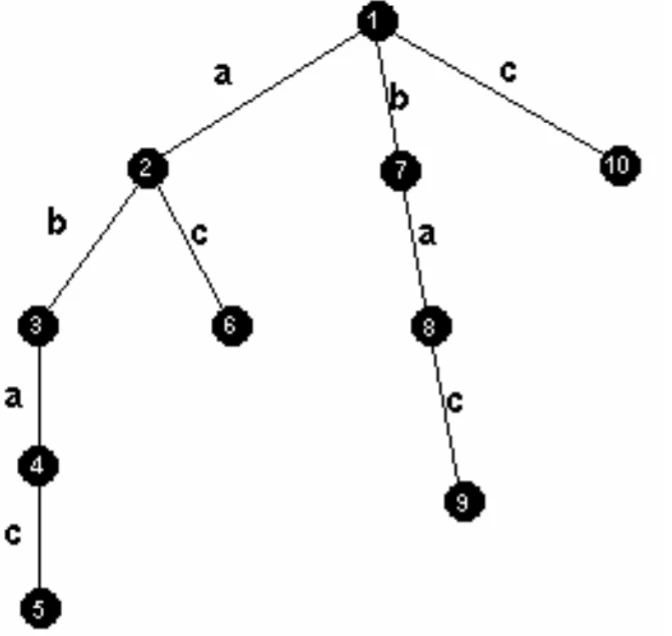
Trie of the suffixes of “abac” (node 1 is the root):
1+-a-- 2| +-b-- 3| | +-a-- 4| | +-c-- 5| +-c-- 6+-b-- 7| +-a-- 8| +-c-- 9+-c-- 10Building Suffix Array:
- Approach 1:
O(n^2 logn). Make an array of all suffixes and then sort the array. If we use anO(n logn)comparison based sorting algorithm, then the total time to make the suffix array would beO(n^2 logn), because string comparison takesO(N)time. - Approach 2:
O(n logn*logn). https://www.hackerearth.com/practice/data-structures/advanced-data-structures/suffix-arrays/tutorial/
class TrieNode { Map<Character, TrieNode> edges; boolean isWordEnd;
TrieNode() { this.edges = new HashMap<>(); this.isWordEnd = false; }}TrieNode root = new TrieNode();public void insert(TrieNode root, String word) { TrieNode currentNode = root; for (char c : word.toCharArray()) { if (!currentNode.edges.containsKey(c)) { currentNode.edges.put(c, new TrieNode()); } currentNode = currentNode.edges.get(c); } currentNode.isWordEnd = true;}public boolean search(TrieNode root, String word) { TrieNode currentNode = root; for (char c : word.toCharArray()) { if (!currentNode.edges.containsKey(c)) { return false; } currentNode = currentNode.edges.get(c); } return currentNode.isWordEnd;}Autocomplete style search over the trie:
class Solution { Node trie; // other code as per problem public List<String> search(String word){ char[] s = word.toCharArray(); int idx = 0; Node t = trie; while(idx < s.length){ // word not found if(!t.next.containsKey(s[idx])) return new ArrayList<>(); t = t.next.get(s[idx]); idx++; } // perform dfs from this node onwards List<String> ans = new ArrayList<>(); ans.addAll(dfs(word, t));
return ans; } public List<String> dfs(String prefix, Node t){ List<String> words = new ArrayList<>(); if(t.isEnd) words.add(prefix); for(int i = 0; i < 26; i++){ char ch = (char)('a'+i); if(t.next.containsKey(ch)) words.addAll(dfs(prefix+ch, t.next.get(ch))); } return words; } public void insert(String word){ char[] s = word.toCharArray(); int idx = 0; Node t = trie; while(idx < s.length && t.next.containsKey(s[idx])){ t = t.next.get(s[idx]); idx++; } // if remaining word is not present in the trie while(idx < s.length){ t.next.put(s[idx], new Node()); t = t.next.get(s[idx]); idx++; } // mark the last character as the terminating t.isEnd = true; }}
class Node{ boolean isEnd = false; Map<Character, Node> next; Node(){ next = new HashMap<>(); }}Sum of prefix scores using a 26-ary trie with a count at each node:
class Trie{ Trie[] ch = new Trie[26]; int count = 0;}
public int[] sumPrefixScores(String[] words) { Trie root = new Trie(); int[] ans = new int[words.length];
// populating the trie for(String word: words){ Trie trie = root; // reference to the actual root of trie for(char c: word.toCharArray()){ if(trie.ch[c-'a'] == null) trie.ch[c-'a'] = new Trie(); // for each character // increment times visited this character(c) trie.ch[c-'a'].count++; // move to the next node trie = trie.ch[c-'a']; } }
// reading the trie for(int i = 0; i < words.length; i++){ Trie trie = root; String word = words[i]; for(char c: word.toCharArray()){ ans[i] += trie.ch[c-'a'].count; trie = trie.ch[c-'a']; } }
return ans;}Modulo arithmetic 1000000007
Section titled “Modulo arithmetic 1000000007”static final int INF = 1000000007;We have stored INF into int dType which can store only upto: INF*2. While solving problems we can encounter situations like INF*5 this won’t fit in an int dType.
System.out.println(INF*3);- Output:
-1294967275
For such situations we use the long dType which is 64 bits. It can even store INF*INF without overflow.
long n = INF*((long)INF);System.out.println(n);- Output:
1000000014000000049
Formulas
Section titled “Formulas”Thus, we can take the remainder after every operation and the numbers will never become too large.
Negative remainders
Section titled “Negative remainders”The remainder of a negative number is either zero or negative.
In JAVA: -13 % 64 = -13 (on modulus 64)
Java developers chose: the sign of the result equals the sign of the dividend. “Mathematically” both are correct:
-13 % 64 = -13(on modulus 64)-13 % 64 = 51(on modulus 64)
An easy way to make sure there are no negative remainders is to first calculate the remainder as usual and then add m if the result is negative.
x = x%m;if (x < 0) x += m;Counting Sort
Section titled “Counting Sort”Here, we create a vector list with max value in the array. Each element in the vector list is the index of that element in the original array: arr. If multiple occurrences of the same element is there we append them to the end of the list. For eg. adj[5] will represent the element with value 5. And it will store the index of occurrences of 5 in arr. Here the value of arr[i] lies in 1 <= arr[i] <= 15.
vector<int> adj[16];int n = arr.size();
for(int i=0;i<n;i++)    adj[arr[i]].push_back(i);
If we need to treat this as a LinkedList, i.e. we could delete the element from the vector list. We create two arrays left and right. The left[i] denotes the index of element left to arr[i] or index of arr[i-1]. Similarly right[i] denotes the index of element to the right of arr[i] i.e. arr[i+1].
int left[n];for(int i=0;i<n;i++) left[i]=i-1;right[n];for(int i=0;i<n;i++) right[i]=i+1;Maintaining these arrays will help us to delete an element from the adj[ ]. To delete the element arr[i] from adj list:
if( left[i] != -1 ) left[ right[i] ] = left[ i ]if( right[i] != n ) right[ left[i] ] = right[ i ]BINARY INDEXED TREE / Fenwick Tree
Section titled “BINARY INDEXED TREE / Fenwick Tree”We are given an array a[], and we want to be able to perform two types of operations on it.
- Given an index
x, find the sum of elements in the array from index 1 to indexx(inclusive). - Given an index
xand a value val, add the value toarr[x].
We maintain an array BIT[] such that, at any index we can store the sum of some numbers of the given array. This can also be called a partial sum tree.
Consider the array (note that the array is considered to be 1 based):
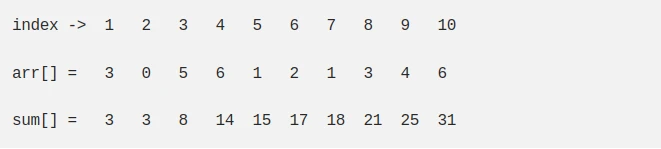
| index | 1 | 2 | 3 | 4 | 5 | 6 | 7 | 8 | 9 | 10 |
|---|---|---|---|---|---|---|---|---|---|---|
arr[] | 3 | 0 | 5 | 6 | 1 | 2 | 1 | 3 | 4 | 6 |
sum[] | 3 | 3 | 8 | 14 | 15 | 17 | 18 | 21 | 25 | 31 |
Every index i in the BIT[] array stores the cumulative sum from the index i to i - (1<<r) + 1 (both inclusive), where r represents the last set bit in the index i.
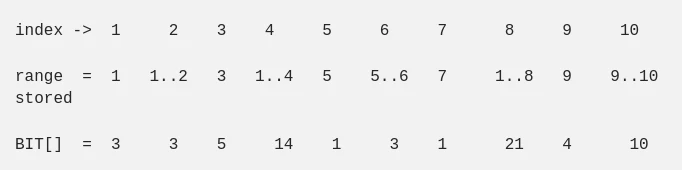
| index | 1 | 2 | 3 | 4 | 5 | 6 | 7 | 8 | 9 | 10 |
|---|---|---|---|---|---|---|---|---|---|---|
| range (stored) | 1 | 1..2 | 3 | 1..4 | 5 | 5..6 | 7 | 1..8 | 9 | 9..10 |
BIT[] | 3 | 3 | 5 | 14 | 1 | 3 | 1 | 21 | 4 | 10 |
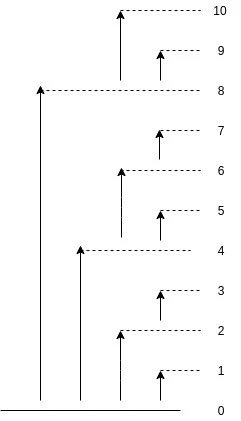
Update-chain diagram (figure): a baseline labeled 0 with dashed guide lines at levels 1 to 10 and upward arrows that link BIT indices. Arrows visible in the figure, read approximately: 0 to 1, 0 to 2, 0 to 4, 0 to 8, 2 to 3, 4 to 5, 4 to 6, 6 to 7, 8 to 9, 8 to 10. Verify exact arrow endpoints against PDF page 71 if they matter.
x & (-x): last set bit
Section titled “x & (-x): last set bit”x&(-x) gives the last set bit in a number x.
Proof of last set bit. Let’s say (in binary) is the number whose last set bit we want to isolate.
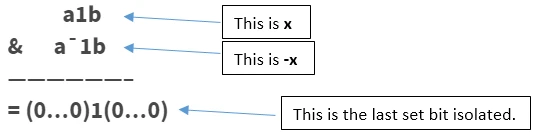
Image (last set bit isolated), page 72:
a1b <- This is x & a'1b <- This is -x ---------- = (0...0)1(0...0) <- This is the last set bit isolated.Range Sum
Section titled “Range Sum”If the given input is 5, then BIT[5] (iteration 1) + BIT[4] (iteration 2) will be returned as the sum.
Or prefix sum till index idx. The loop will remove the rightmost set bit until the idx doesn’t have any more set bits.
int get(int idx){ int sum = 0; idx = idx + 1; // if your array is one based then remove this while (idx>0) { sum += BIT[idx]; // add the value idx -= idx & (-idx); // remove the last set bit } return sum;}Point Update
Section titled “Point Update”Here the idx is being updated until the idx becomes greater than N. The rightmost bit is added.
If we update idx: 1, this change will be added to every sub range which includes this idx: 1.
void update(int idx, int val){ idx = idx + 1; // if your query is one based then remove this while (idx <= N){ BIT[idx] += val; idx += idx & (-idx); }}All paths from root to leaves
Section titled “All paths from root to leaves”public void allPaths(TreeNode root,TreeNode parent,List<Integer> p){ if(root == null) return;
p.add(root.val); if(root.left == null && root.right == null) paths.add((List<Integer>)p.clone()); prefixTree(root.left,root,p); prefixTree(root.right,root,p); p.remove(p.size()-1);}PreOrder Traversal
Section titled “PreOrder Traversal”public List<Integer> preorderTraversal(TreeNode root) { List<Integer> result = new ArrayList<>(); Deque<TreeNode> stack = new ArrayDeque<>(); TreeNode p = root; while(!stack.isEmpty() || p != null) { if(p != null) { stack.push(p); result.add(p.val); // Add before going to children p = p.left; } else { TreeNode node = stack.pop(); p = node.right; } } return result;}Inorder Traversal
Section titled “Inorder Traversal”public List<Integer> inorderTraversal(TreeNode root) { List<Integer> result = new ArrayList<>(); Deque<TreeNode> stack = new ArrayDeque<>(); TreeNode p = root; while(!stack.isEmpty() || p != null) { if(p != null) { stack.push(p); p = p.left; } else { TreeNode node = stack.pop(); result.add(node.val); // Add after all left children p = node.right; } } return result;}Postorder Traversal
Section titled “Postorder Traversal”public List<Integer> postorderTraversal(TreeNode root) { LinkedList<Integer> result = new LinkedList<>(); Deque<TreeNode> stack = new ArrayDeque<>(); TreeNode p = root; while(!stack.isEmpty() || p != null) { if(p != null) { stack.push(p); result.addFirst(p.val); // Reverse the process of preorder p = p.right; // Reverse the process of preorder } else { TreeNode node = stack.pop(); p = node.left; // Reverse the process of preorder } } return result;}BST Iterator
Section titled “BST Iterator”Implement an iterator over a binary search tree (BST). Your iterator will be initialized with the root node of a BST.
The first call to next() will return the smallest number in BST. Calling next() again will return the next smallest number in the BST, and so on.
Solution: It is another tricky form of tree traversal especially for BST. The idea is similar to inorder traversal. Here we first put all left most nodes in the stack, (now the top of stack contains the minimum element), before returning this element we add all the left-most nodes of minimum_node.right subtree.
public class Solution { Stack<TreeNode> pre; public Solution(TreeNode root) { TreeNode t = root; pre = new Stack<>(); while(t!=null){ pre.push(t); t = t.left; } }
/** @return the next smallest number */ public int next() { TreeNode pop = pre.pop(); TreeNode t = pop.right; while(t!=null){ pre.push(t); t = t.left; } return pop.val; }}This approach can be used to solve: 2-Sum Binary Tree. Given a binary search tree T, where each node contains a positive integer, and an integer K, you have to find whether or not there exist two different nodes A and B such that A.value + B.value = K.
We use two pointer approach when solving this problem for sorted array. Here we can do the similar thing. By making use of two iterators, one of which tracks the minimum element, other tracks the maximum element.
Lowest Common Ancestor of a Binary Tree
Section titled “Lowest Common Ancestor of a Binary Tree”Lowest Common Ancestor of a Binary Tree
Section titled “Lowest Common Ancestor of a Binary Tree”Page 90 (image):
public TreeNode lowestCommonAncestor(TreeNode root, TreeNode p, TreeNode q) { if(root == null) return null; if(root == p || root == q) return root; TreeNode lft = lowestCommonAncestor(root.left,p,q); TreeNode rgt = lowestCommonAncestor(root.right,p,q); if(lft != null && rgt != null) return root; return (lft != null)?lft:rgt;}Page 90 (image):
public TreeNode lowestCommonAncestor(TreeNode root, TreeNode p, TreeNode q) { if(root == null) return null; int lft = find(root.left,p.val,q.val); int rgt = find(root.right,p.val,q.val); if(lft == 1 && rgt == 1) return root; else if(lft == 1 && (root.val == p.val || root.val == q.val)) return root; else if(rgt == 1 && (root.val == p.val || root.val == q.val)) return root; else if(lft == 2) return lowestCommonAncestor(root.left,p,q); else if(rgt == 2) return lowestCommonAncestor(root.right,p,q); else return null;}public int find(TreeNode root, int p,int q){ if(root == null) return 0; if(root.val == p || root.val == q) return 1 + find(root.left, p, q) + find(root.right, p, q); else return find(root.left, p, q) + find(root.right, p, q);}Page 91 (image):
private boolean recurseTree(TreeNode currentNode, TreeNode p, TreeNode q) { // If reached the end of a branch, return false. if (currentNode == null) return false;
// Left Recursion. If left recursion returns true, set left = 1 else 0 int left = recurseTree(currentNode.left, p, q) ? 1 : 0;
// Right Recursion int right = recurseTree(currentNode.right, p, q) ? 1 : 0;
// If the current node is one of p or q int mid = (currentNode == p || currentNode == q) ? 1 : 0;
// If any two of the flags left, right or mid become True if (mid + left + right >= 2) ans = currentNode;
// Return true if any one of the three bool values is True. return (mid + left + right > 0);}Page 92 (image):
public TreeNode lowestCommonAncestor(TreeNode root, TreeNode p, TreeNode q) { Map<TreeNode, TreeNode> parent = new HashMap<>(); Deque<TreeNode> stack = new ArrayDeque<>(); parent.put(root, null); stack.push(root);// create the parent dictionary while (!parent.containsKey(p) || !parent.containsKey(q)) { TreeNode node = stack.pop(); if (node.left != null) { parent.put(node.left, node); stack.push(node.left); } if (node.right != null) { parent.put(node.right, node); stack.push(node.right); } }// check for parent having both p and q as childeren Set<TreeNode> ancestors = new HashSet<>(); while (p != null) { ancestors.add(p); p = parent.get(p); } while (!ancestors.contains(q)) q = parent.get(q); return q;}Page 93 (image), alternative approach:
Another solution is to run DFS for both p and q values and create paths from root to p and q. These paths can be stored in lists. Since we need lowest common ancestor, we can check from the front for the last such node which is common in both the lists.
Running time:
- DFS will lead to
O(N)since this is a binary tree and not a binary search tree. - Two DFS operations will lead to
O(N)
Comparison work of the lists - using a while loop - to find common element will take O(N)
- So total running time -
O(N)
Space
- Lists to store paths can lead to
O(N)
Binary Search
Section titled “Binary Search”JAVA Binary Search function
Section titled “JAVA Binary Search function”If A[] is a sorted array, then Arrays.binarySearch(A, key) and Arrays.binarySearch(A,fromIndex,toIndex(exlude),key) will search the first occurrence of key in the array A, if it is not present then it will return (-(insertion point) - 1).
Insertion point is the index of the first element greater than the key, or A.length.
Let idx = Arrays.binarySearch(A,key) and ceil = -1*idx -1;
Finding the Ceil (>= key): idx = idx>=0?idx: ceil;
Finding the Floor (<= key):
if(ceil == A.length) idx = A.length-1;else idx = idx>=0?idx:(A[ceil] > key?ceil-1:ceil);Simple Binary Search
Section titled “Simple Binary Search”int binarySearch(int Arr[], int n, int target) { //set starting and ending index int start = 0, end = n-1; while(start <= end) { // take mid of the list int mid = (start + end) / 2; // we found a match if(Arr[mid] == target) return mid; // go on right side else if(Arr[mid] < target) start = mid + 1; // go on left side else end = mid - 1; } // element is not present in list return -1;}Things to Note here:
- The start pointer will always point to
num >= target - The end pointer will always point to
num <= target - When
start == endthen at this point the target should have been present (if it was absent). - Binary search takes ~30 steps to search any number between [1, INTEGER_MAX]

Image (binary search on key = 5 over [1, 2, 3, 4, 5, 6, 7], page 95): three steps:
- Step 1: start (value 1), middle (value 4), end (value 7). Search ‘key’ = ‘5’. As key >
arr[middle], therefore start = middle + 1. - Step 2: remaining window is 5, 6, 7 with start, middle (6), end (7). As key <
arr[middle], therefore end = middle - 1. - Step 3: start, middle, end all point to 5. As key ==
arr[middle], return middle as the required index.
Beyond Sorted Array Binary Search
Section titled “Beyond Sorted Array Binary Search”Similar thing can be done with monotonic functions (monotonically increasing or decreasing) as well.
Let’s say we have f(x) which increases when x increases.
So, given a problem of finding x so that f(x) = p, I can do a binary search for x. At any instance,
- if
f(current_position)> p, then I will search for values lower than current_position. - if
f(current_position)< p, then I will search for values higher than current_position. - if
f(current_position)= p, then I have found my answer.
Matrix Median (IB)
Section titled “Matrix Median (IB)”Given a matrix of integers A of size N x M in which each row is sorted. Find and return the overall median of the matrix A.
Solution:
We cannot use extra memory, so we can’t actually store all elements in an array and sort the array. But since rows are sorted it must be of some use, right?
Note that in a row you can binary search to find how many elements are smaller than a value X in . // M == no. of columns. This is the base of our solution.
Say k = N*M/2. We need to find (k + 1)th smallest element. We can use binary search on answer. In , we can count how many elements are smaller than X in the matrix.
So, we use binary search on interval [1, INT_MAX]. So, total complexity is .
Ceiling and Floor of a number
Section titled “Ceiling and Floor of a number”The ceiling of the ‘key’ will be the smallest element in the given array greater than or equal to the ‘key’.
- Input: [1, 3, 8, 10, 15], key = 12
- Output: 4
- Explanation: The smallest number greater than or equal to ‘12’ is ‘15’ having index ‘4’.
If we find the ‘key’, we return its index as the ceiling. If we can’t find the ‘key’, the next big number will be pointed out by the index start.
// arr is sorted in ascending orderpublic static int ceiling(int[] arr, int key){ int l = 0, r = arr.length-1; while(l <= r){ int mid = l + (r-l)/2; if(arr[mid] == key) return mid; else if(arr[mid] > key) r = mid - 1; else l = mid + 1; } // we did not found key then we reach this point // when l == r then at this point the key should have been present ifA[l] > key this means this the element present is greater than key so wemake r = l-1. This means A[r] <= key and A[l] >= key. return l;}Next Greater number
Section titled “Next Greater number”Find the smallest letter in the given array greater than a given ‘key’. Given array is a circular list.
- Input: [‘a’, ‘c’, ‘f’, ‘h’], key = ‘f’
- Output: ‘h’
- Explanation: The smallest letter greater than ‘f’ is ‘h’ in the given array.
- The array is considered circular, which means if the ‘key’ is bigger than the last letter of the array or if it is smaller than the first letter of the array, the key’s next letter will be the first letter of the array.
- The other difference is that we have to find the next biggest letter which can’t be equal to the ‘key’. This means that we will ignore the case where key ==
arr[middle]. To handle this case, we can update our start range to start = middle +1.
public int nextGreater(int[] arr, int x){ if(x > arr[arr.length-1] || x < arr[0]) return 0; int l = 0, r = arr.length-1; while(l <= r){ int mid = l + (r-l)/2; if(arr[mid] > x) r = mid - 1; else l = mid + 1; } return l%arr.length;}Bitonic Array Maximum
Section titled “Bitonic Array Maximum”Find the maximum value in a given Bitonic array. An array is considered bitonic if it is monotonically increasing and then monotonically decreasing (no two consecutive numbers are same).

Image (example, page 98):
Input: [1, 3, 8, 12, 4, 2]Output: 12Explanation: The maximum number in the input bitonic array is '12'.Solution: whenever we calculate the middle, we can compare the numbers pointed out by the index middle and middle+1 to find if we are in the ascending or the descending part.
- If
arr[middle]>arr[middle + 1], we are in the second (descending) part of the bitonic array. Therefore, our required number could either be pointed out by middle or will be before middle. This means we will be doing: end = middle. - If
arr[middle]<=arr[middle + 1], we are in the first (ascending) part of the bitonic array. Therefore, the required number will be after middle. This means we will be doing: start = middle + 1.
We can break when start == end.
Image (page 98):
public int find_max_bitonic(int[] arr){ int l = 0, r = arr.length-1; while(l < r){ int mid = ( l + r )/2; if(arr[mid] > arr[mid+1]) // descending r = mid; else l = mid + 1; // ascending } return l;}Search in Rotated Array
Section titled “Search in Rotated Array”Given an array of numbers which is sorted in ascending order and also rotated by some arbitrary number, find if a given ‘key’ is present in it.
Write a function to return the index of the ‘key’ in the rotated array. If the ‘key’ is not present, return -1. You can assume that the given array does not have any duplicates.
Solution:
After calculating the middle, we can compare the numbers at indices start and middle. This will give us two options:
- If
arr[start]<=arr[middle], the numbers from start to middle are sorted in ascending order. - Else, the numbers from middle+1 to end are sorted in ascending order.

Image (example, page 99):
Input: [4, 5, 7, 9, 10, -1, 2], key = 10Output: 4Explanation: '10' is present in the array at index '4'.
Image (page 99): original array [-1, 2, 4, 5, 7, 9, 10] and the array after 5 rotations [4, 5, 7, 9, 10, -1, 2].
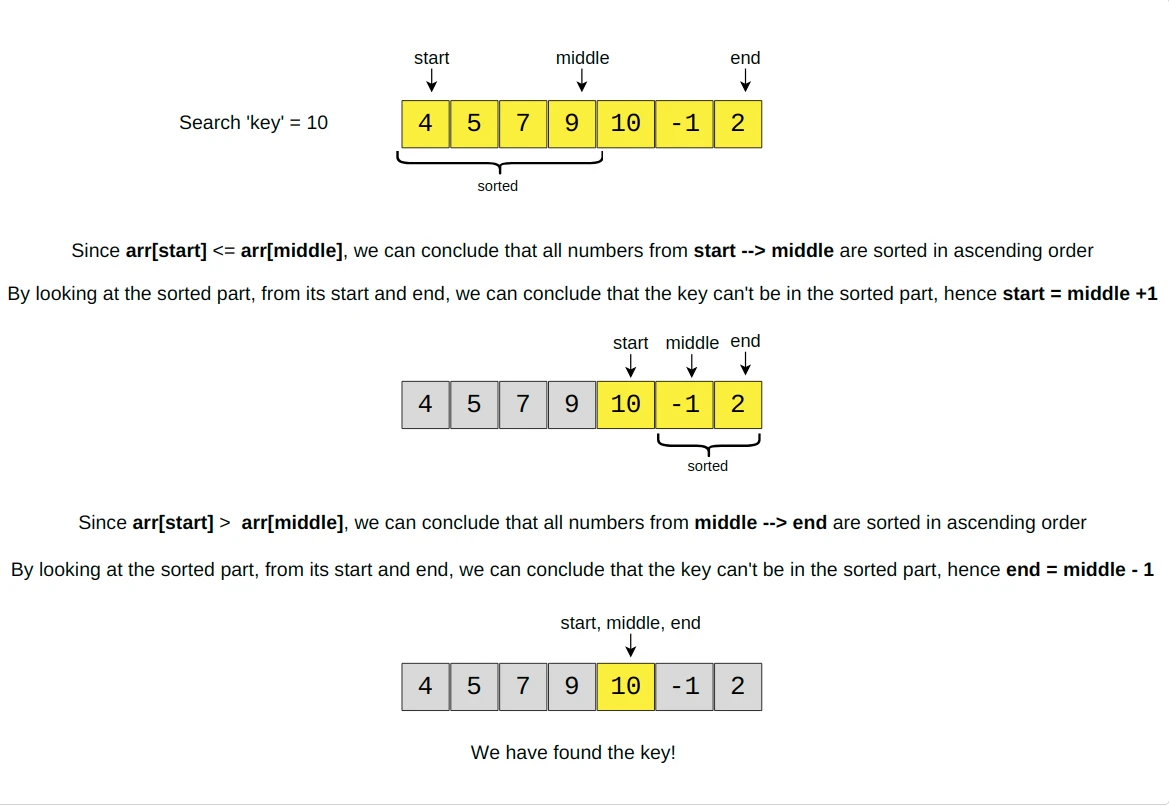
Image (search walkthrough for key = 10, page 100):
- Step 1: start, middle (9), end. Since
arr[start]<=arr[middle], we can conclude that all numbers from start —> middle are sorted in ascending order. By looking at the sorted part, from its start and end, we can conclude that the key can’t be in the sorted part, hence start = middle +1. - Step 2: start, middle (-1), end (2) over
[10, -1, 2]. Sincearr[start]>arr[middle], we can conclude that all numbers from middle —> end are sorted in ascending order. By looking at the sorted part, from its start and end, we can conclude that the key can’t be in the sorted part, hence end = middle - 1. - Step 3: start, middle, end all point to 10. We have found the key!
Image (page 101):
public int search(int[] nums, int target) { int l = 0, r = nums.length-1; while(l <= r){ int mid = (l + r) / 2; if(nums[mid] == target) return mid; if(nums[l] <= nums[mid]) {// left part is sorted if(target >= nums[l] && target < nums[mid]) r = mid-1; else l = mid+1; // go to the right part } else { // right part is sorted if(target > nums[mid] && target <= nums[r]) l = mid+1; else r = mid-1; } } return -1;}Rotation Count or Find Minimum in Rotated Sorted Array
Section titled “Rotation Count or Find Minimum in Rotated Sorted Array”Given an array of numbers which is sorted in ascending order and is rotated ‘k’ times around a pivot, find ‘k’.
Solution:
An interesting fact about the minimum element is that it is the only element in the given array which is smaller than its previous element.
After calculating the middle, we can compare the number at index middle with its previous and next number. This will give us two options:
- If
arr[middle]>arr[middle + 1], then the element at middle + 1 is the smallest. - If
arr[middle - 1]>arr[middle], then the element at middle is the smallest.
To adjust the ranges:
- If
arr[start]<arr[middle], the numbers from start to middle are sorted. - Else, the numbers from middle to end are sorted.
Image (page 102):
public int findMin(int[] nums) { int l = 0, r = nums.length-1; while(l < r){ int mid = (l+r)/2; if(mid > l && nums[mid] < nums[mid-1]) return mid; if(mid < r && nums[mid] > nums[mid+1]) return nums[mid+1];
if(nums[mid] > nums[l]) // left is sorted l to mid l = mid+1; else r = mid; } return 0; // not rotated}Two Pointers
Section titled “Two Pointers”We deal with sorted arrays (or LinkedLists) and need to find a set of elements that fulfill certain constraints.
Q. Given an array of sorted numbers and a target sum, find a pair in the array whose sum is equal to the given target.
- Input: [1, 2, 3, 4, 6], target=6
- Output: [1, 3]
- Explanation: The numbers at index 1 and 3 add up to 6: 2+4=6
Given that the input array is sorted, an efficient way would be to start with one pointer in the beginning and another pointer at the end. At every step, we will see if the numbers pointed by the two pointers add up to the target sum.
If they do not, we will do one of two things:
- If the sum of the two numbers pointed by the two pointers is greater than the target sum, this means that we need a pair with a smaller sum. So, to try more pairs, we can decrement the end-pointer.
- If the sum of the two numbers pointed by the two pointers is smaller than the target sum, this means that we need a pair with a larger sum. So, to try more pairs, we can increment the start-pointer.
public int[] TwoSum(int[] A, int target){ int left = 0, right = A.length-1; // as same number cannot be counted twice while(left < right){ int pair = A[left] + A[right]; if(target == pair) return new int[]{left,right}; else if(target > pair) left++; else right++; } return new int[0]; // not found}Longest Substring with Same Letters after Replacement
Section titled “Longest Substring with Same Letters after Replacement”Given a string with lowercase letters only, if you are allowed to replace no more than ‘k’ letters with any letter, find the length of the longest substring having the same letters after replacement.

Image (examples, page 103):
Input: String="aabccbb", k=2Output: 5Explanation: Replace the two 'c' with 'b' to have a longest repeating substring "bbbbb".
Input: String="abbcb", k=1Output: 4Explanation: Replace the 'c' with 'b' to have a longest repeating substring "bbbb".
Solution: We can use a HashMap to count the frequency of each letter. We’ll iterate through the string to add one letter at a time in the window. We’ll also keep track of the count of the maximum repeating letter in any window (let’s call it maxRepeatLetterCount). So at any time, we know that we can have a window which has one letter repeating maxRepeatLetterCount times, this means we should try to replace the remaining letters. If we have more than ‘k’ remaining letters, we should shrink the window as we are not allowed to replace more than ‘k’ letters.
Image (page 104):
public static int findLength(String s, int k){ int windowStart = 0, maxLength = 0, maxRepeatingLetterCount = 0; int[] map = new int[26]; // frequency table char[] str = s.toCharArray(); for(int windowEnd = 0; windowEnd < str.length; windowEnd++){ map[str[windowEnd]-'a']++; maxRepeatingLetterCount = Math.max(maxRepeatingLetterCount, map[str[windowEnd]-'a']); // if the no of different characters are greater than k if(windowEnd-windowStart+1 - maxRepeatingLetterCount > k) windowStart++; maxLength = Math.max(maxLength, windowEnd-windowStart+1); } return maxLength;}String
Section titled “String”KMP algorithm
Section titled “KMP algorithm”https://www.youtube.com/watch?v=BXCEFAzhxGY B2B swe
We make a prefix suffix array (or longest proper prefix which is also suffix, lps array). Of which each “i”th element tells the end position of longest prefix that matches the suffix (which is the “i”th element) in the substring starting with 0th index and ending at index i.
Eg.: d s g w a d s g z (in this example the ith element tells the end position of longest prefix + 1)
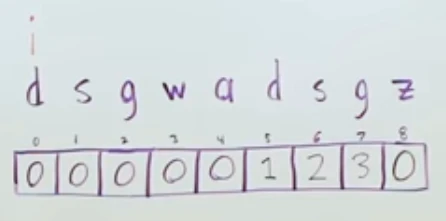
Image (page 104, lps example for d s g w a d s g z):
idx: 0 1 2 3 4 5 6 7 8Eg.: d s g w a d s g zlps: 0 0 0 0 0 1 2 3 0Image (page 105, lps example for A A C E C A A A A $ A A A A C E C A A):
idx : 0 1 2 3 4 5 6 7 8 9 10 11 12 13 14 15 16 17 18Eg. : A A C E C A A A A $ A A A A C E C A Alps :{0, 1, 0, 0, 0, 1, 2, 2, 2, 0, 1, 2, 2, 2, 3, 4, 5, 6, 7}With comments:
public static int[] getlps(String str){ int l = 0, lps[] = new int[str.length()], n = str.length(); char[] S = str.toCharArray(); // the first term always has prefix == suffix == 0 for(int r = 1; r < n; r++){ // if a prefix == suffix found if(S[l] == S[r]) lps[r] = ++l; // if the current_prefix != suffix and the l has elements to it's left // remember : dsgwadsgz else if(l != 0){ // lps[l-1] gives me previous (longest prefix for 0 to l-1) + 1 l = lps[l-1]; // we check, if any previous prefix that matches current suffix // so we don't need to increment r in next iteration r--; } // we have l == 0 and s[l] != s[r] we cannot go back to make theprefix == suffix else lps[r] = 0; } System.out.println(Arrays.toString(lps)); return lps;}Without comments:
public static int[] getlps(String str){ int l = 0, lps[] = new int[str.length()], n = str.length(); char[] S = str.toCharArray(); for(int r = 1; r < n; r++){ if(S[l] == S[r]) lps[r] = ++l; else if(l != 0){ l = lps[l-1]; r--; } else lps[r] = 0; } return lps;}Tricky / Important problems
Section titled “Tricky / Important problems”These are frequently asked LeetCode patterns: multi-source BFS, union-find on coordinates, sliding window, intervals, cyclic sort, tree DFS with prefix sums, backtracking and DP.
542. 01 Matrix
Section titled “542. 01 Matrix”Given a matrix consists of 0 and 1, find the distance of the nearest 0 for each cell. The distance between two adjacent cells is 1.
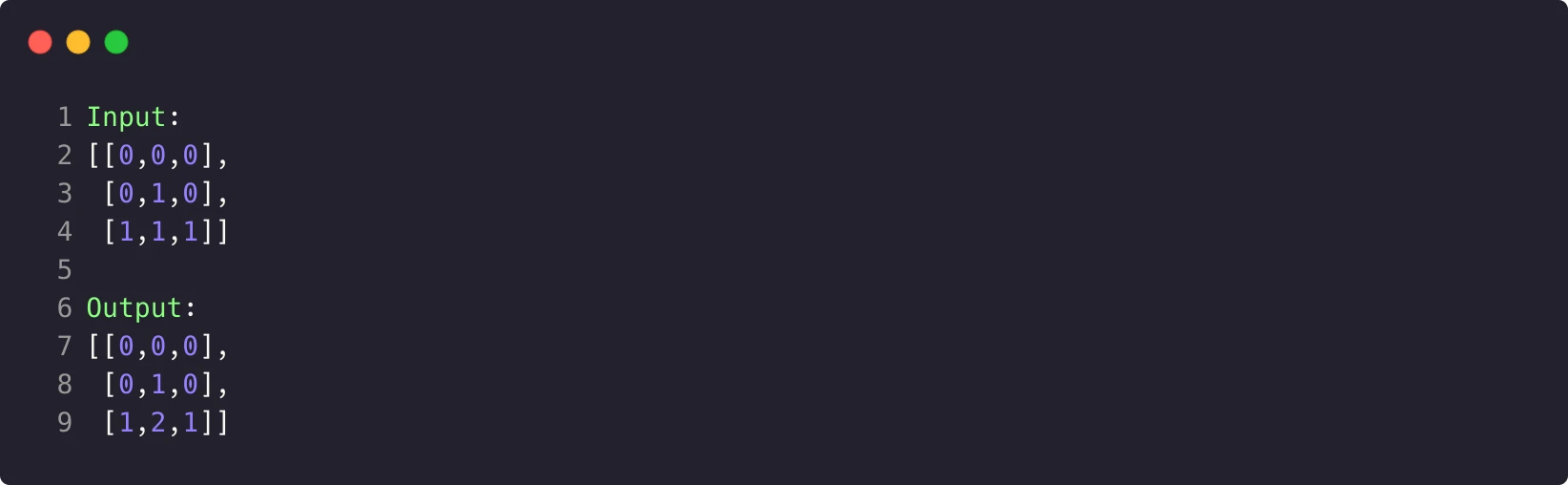
Image (example, page 106):
Input:[[0,0,0], [0,1,0], [1,1,1]]
Output:[[0,0,0], [0,1,0], [1,2,1]]
Using BFS
Image (BFS solution, page 107):
public int[][] updateMatrix(int[][] matrix) { if(matrix.length == 0) return matrix; int m = matrix.length, n = matrix[0].length; Queue<int[]> q = new LinkedList<>(); for(int i = 0; i < m; i++) for(int j = 0; j < n; j++){ if(matrix[i][j] == 0) q.add(new int[]{i,j}); else matrix[i][j] = Integer.MAX_VALUE; } while(!q.isEmpty()){ int size = q.size(); for(int i = 0; i < size; i++){ int[] coord = q.poll(); int[][] directions = { {-1,0},{1,0},{0,-1},{0,1} }; for(int[] dir: directions){ int x = coord[0] + dir[0], y = coord[1] + dir[1]; if(x < 0 || y < 0 || x >= m || y >= n) continue; if(matrix[x][y] > matrix[coord[0]][coord[1]]+1){ matrix[x][y] = matrix[coord[0]][coord[1]]+1; q.add(new int[]{x,y}); } } } } return matrix;}Using DP
(Page 107 shows only the heading “Using DP”; no DP content or image is present in the source chunk for this page.)
417. Pacific Atlantic Water Flow
Section titled “417. Pacific Atlantic Water Flow”Given an m x n matrix of non-negative integers representing the height of each unit cell in a continent.
The “Pacific ocean” touches the left and top edges of the matrix and the “Atlantic ocean” touches the right and bottom edges.
Water can only flow in four directions (up, down, left, or right) from a cell to another one with height equal or lower.
Find the list of grid coordinates from where water can flow to both the Pacific and Atlantic ocean.
Code (image on p.108, no caption in the PDF; appears to be the 01 Matrix solution)
Section titled “Code (image on p.108, no caption in the PDF; appears to be the 01 Matrix solution)”public int[][] updateMatrix(int[][] matrix) { if(matrix.length == 0) return matrix; int m = matrix.length, n = matrix[0].length, max_distance = m*n; int[][] distance = new int[m][n]; // first check all paths from up and left for(int i = 0; i < m; i++) for(int j = 0; j < n; j++){ if(matrix[i][j] == 0) distance[i][j] = 0; else { int up = (i > 0)?distance[i-1][j]: max_distance; int left = (j > 0)?distance[i][j-1]: max_distance; distance[i][j] = 1 + Math.min(up,left); } } // then check all paths from down and right for(int i = m-1; i >= 0; i--) for(int j = n-1; j >= 0; j--){ if(matrix[i][j] == 0) distance[i][j] = 0; else { int down = (i < m-1)?distance[i+1][j]: max_distance; int right = (j < n-1)?distance[i][j+1]: max_distance; distance[i][j] = Math.min(distance[i][j], 1 + Math.min(down,right)); } } // we can also use the same matrix return distance;}417. Pacific Atlantic Water Flow (solution)
Section titled “417. Pacific Atlantic Water Flow (solution)”Grid example
Section titled “Grid example”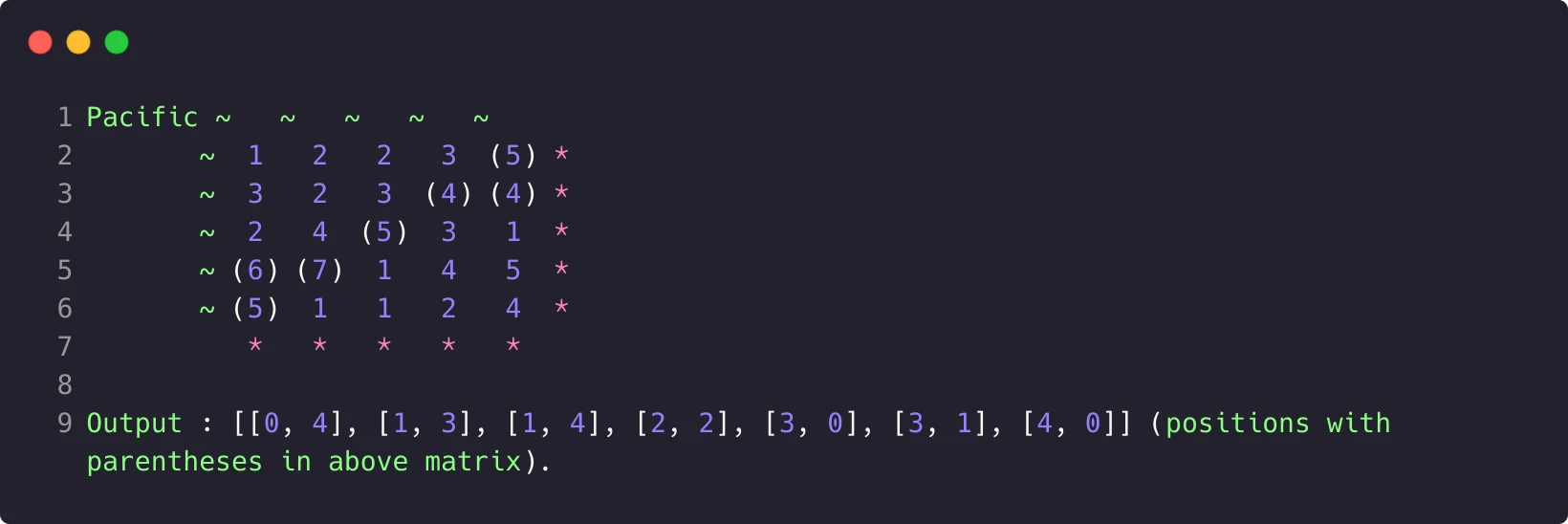
Heights matrix; cells in parentheses are the positions that can reach both oceans. * marks the Atlantic/Pacific border side indicators as in the figure:
Pacific ~ ~ ~ ~ ~ ~ 1 2 2 3 (5) * ~ 3 2 3 (4) (4) * ~ 2 4 (5) 3 1 * ~ (6) (7) 1 4 5 * ~ (5) 1 1 2 4 * * * * * *- Output:
[[0, 4], [1, 3], [1, 4], [2, 2], [3, 0], [3, 1], [4, 0]](positions with parentheses in above matrix).
public List<List<Integer>> pacificAtlantic(int[][] matrix) { List<List<Integer>> ans = new ArrayList<>(); if(matrix.length == 0) return ans; int m = matrix.length, n = matrix[0].length; int[][] visited = new int[m][n]; // pacific -> 1, atlantic -> 2, both -> 3 for(int i = 0; i < m; i++) // leftCol is connected to pacific ff(i,0,1,visited,matrix); for(int i = 0; i < n; i++) // topRow is connected to pacific ff(0,i,1,visited,matrix); for(int i = 0; i < m; i++) // rgtCol is connected to atlantic ff(i,n-1,2,visited,matrix); for(int i = 0; i < n; i++) // bottomRow is conn. to atlantic ff(m-1,i,2,visited,matrix);
for(int i = 0; i < m; i++) for(int j = 0; j < n; j++) if(visited[i][j] == 3) ans.add(Arrays.asList(i,j));
return ans;}
public void ff(int i,int j,int color,int[][] visited,int[][] matrix){ if(i < 0 || j < 0 || i >= matrix.length || j >= matrix[0].length) return; if(visited[i][j] >= color) return; visited[i][j] += color; int[][] directions = { {-1,0}, {1,0}, {0,-1}, {0,1} }; for(int[] dir: directions){ int x = dir[0] + i, y = dir[1] + j; if(x < 0 || y < 0 || x >= matrix.length || y >= matrix[0].length) continue; if(matrix[x][y] >= matrix[i][j]) ff(x,y,color,visited,matrix); }}947. Most Stones Removed with Same Row or Column
Section titled “947. Most Stones Removed with Same Row or Column”On a 2D plane, we place stones at some integer coordinate points. Each coordinate point may have at most one stone.
Now, a move consists of removing a stone that shares a column or row with another stone on the grid.
What is the largest possible number of moves we can make?
Examples
Section titled “Examples”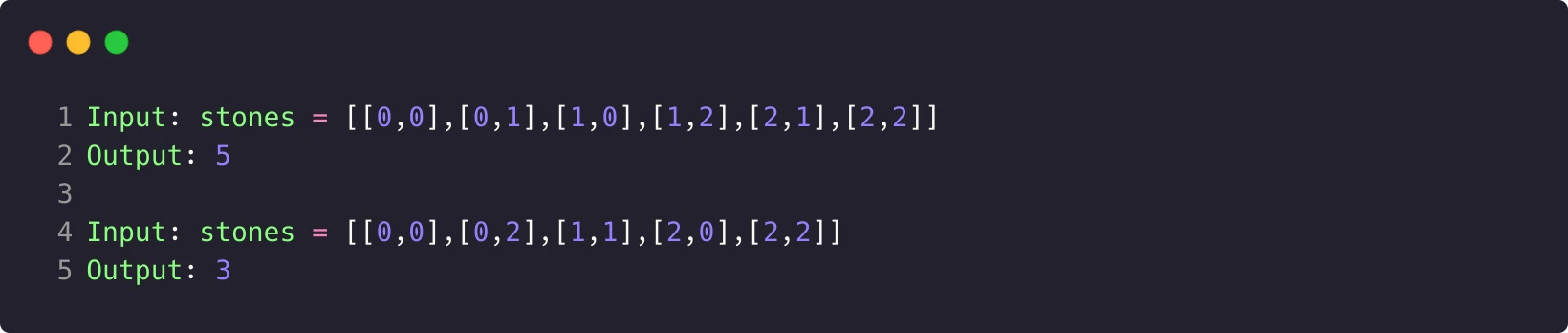
Input: stones = [[0,0],[0,1],[1,0],[1,2],[2,1],[2,2]]Output: 5
Input: stones = [[0,0],[0,2],[1,1],[2,0],[2,2]]Output: 3
Solution
Section titled “Solution”First build the graph by connecting stones in same row/col, then we can reduce all the stones in a connected component to 1 stone.
static int[] nodes; // nodes[i] is no. of nodes in connected component with root "i"public int removeStones(int[][] stones) { if(stones.length == 0) return 0; int[] ufds = new int[stones.length]; nodes = new int[stones.length]; Arrays.fill(nodes,1); // all components will have a single nodes Arrays.fill(ufds,-1); int ans = 0;
for(int i = 0; i < stones.length; i++) for(int j = i+1; j < stones.length; j++){ if(find(i,ufds) == find(j,ufds)) continue; if(stones[i][0] == stones[j][0] || stones[i][1] == stones[j][1]){ union(i,j,ufds); } } // for each connected component get the no. of nodes for(int i = 0; i < stones.length; i++) if(ufds[i] == -1) ans += nodes[i]-1; return ans;}public int find(int x,int[] ufds){ if(ufds[x] == -1) return x; return ufds[x] = find(ufds[x],ufds);}public void union(int u,int v,int[] ufds){ // increase the connected nodes of component with root v nodes[find(v,ufds)] += nodes[find(u,ufds)]; ufds[find(u,ufds)] = find(v,ufds);}1423. Maximum Points You Can Obtain from Cards
Section titled “1423. Maximum Points You Can Obtain from Cards”There are several cards arranged in a row, and each card has an associated number of points. The points are given in the integer array cardPoints.
In one step, you can take one card from the beginning or from the end of the row. You have to take exactly k cards.
Your score is the sum of the points of the cards you have taken.
Given the integer array cardPoints and the integer k, return the maximum score you can obtain.
Examples
Section titled “Examples”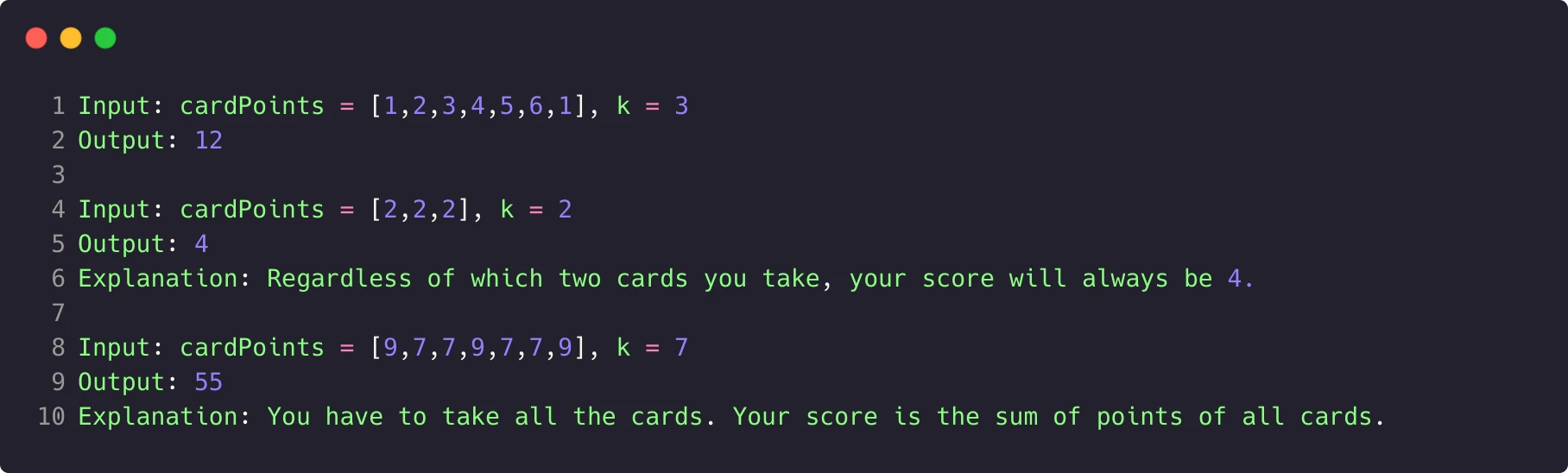
Input: cardPoints = [1,2,3,4,5,6,1], k = 3Output: 12
Input: cardPoints = [2,2,2], k = 2Output: 4Explanation: Regardless of which two cards you take, your score will always be 4.
Input: cardPoints = [9,7,7,9,7,7,9], k = 7Output: 55Explanation: You have to take all the cards. Your score is the sum of points of all cards.
Sliding window+DP
Section titled “Sliding window+DP”public int maxScore(int[] cards, int k) { int[] dp = new int[k+1]; int ans = 0; for(int i = cards.length-1; i>=cards.length-k; i--) dp[0] += cards[i]; ans = dp[0]; for(int i = 1; i <= k; i++){ dp[i] = dp[i-1] + cards[i-1] - cards[cards.length-k+i-1]; ans = Math.max(ans,dp[i]); } return ans;}Diagram (sliding window over an 9-card array, indices 0-8)
Section titled “Diagram (sliding window over an 9-card array, indices 0-8)”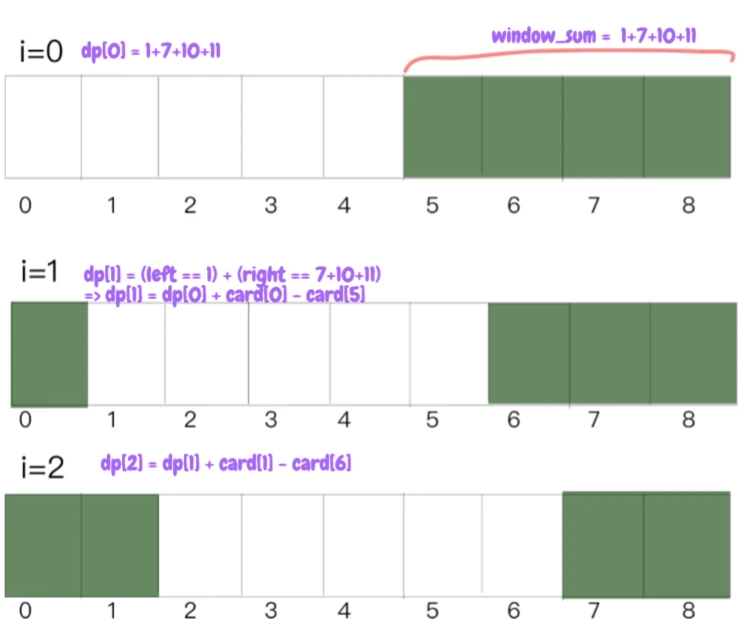
i=0: dp[0] = 1+7+10+11 (window_sum = 1+7+10+11, the last 4 cards = indices 5..8)     indices: 0 1 2 3 4 | 5 6 7 8   (window = 5..8)
i=1: dp[1] = (left == 1) + (right == 7+10+11)     => dp[1] = dp[0] + card[0] - card[5]     window = 0 | 6 7 8
i=2: dp[2] = dp[1] + card[1] - card[6]     window = 0 1 | 7 8
1452. People Whose List of Favorite Companies Is Not a Subset of Another List
Section titled “1452. People Whose List of Favorite Companies Is Not a Subset of Another List”Given the array favoriteCompanies where favoriteCompanies[i] is the list of favorites companies for the ith person (indexed from 0).
Return the indices of people whose list of favorite companies is not a subset of any other list of favorites companies. You must return the indices in increasing order.
UNION FIND
Example
Section titled “Example”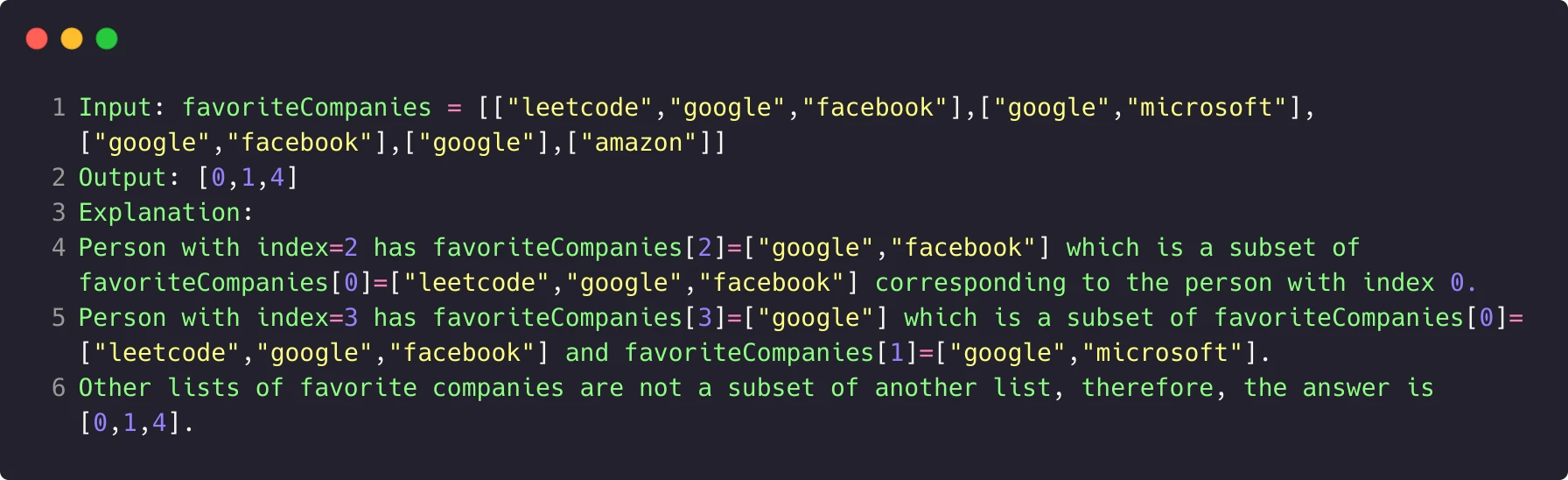
Input: favoriteCompanies = [["leetcode","google","facebook"],["google","microsoft"],["google","facebook"],["google"],["amazon"]]Output: [0,1,4]Explanation:Person with index=2 has favoriteCompanies[2]=["google","facebook"] which is a subset offavoriteCompanies[0]=["leetcode","google","facebook"] corresponding to the person with index 0.Person with index=3 has favoriteCompanies[3]=["google"] which is a subset of favoriteCompanies[0]=["leetcode","google","facebook"] and favoriteCompanies[1]=["google","microsoft"].Other lists of favorite companies are not a subset of another list, therefore, the answer is[0,1,4].static int[] ufds;public List<Integer> peopleIndexes(List<List<String>> fc) { Set<String>[] ps = new Set[fc.size()]; for(int i = 0; i < ps.length; i++) ps[i] = new HashSet<>(fc.get(i)); // ufds[i] stores the subset number which stores all the nodes ufds = new int[ps.length]; Arrays.fill(ufds,-1);
for(int i = 0; i < ps.length; i++) for(int j = i+1; j < ps.length; j++){ if(find(i) == find(j)) continue; else if(contains(ps[find(i)],ps[find(j)])) ufds[find(j)] = find(i); else if(contains(ps[find(j)],ps[find(i)])) ufds[find(i)] = find(j); } List<Integer> ans = new ArrayList<>(); for(int i = 0; i < ps.length; i++) if(ufds[i] == -1) ans.add(i); return ans;}public int find(int x){ if(ufds[x] == -1) return x; return find(ufds[x]);}// Using Set will lead to : containsAll() will be O(n)public boolean contains(Set<String> a,Set<String> b){ if(a.size()<=b.size()) return false; return a.containsAll(b);}Typical union-find
Section titled “Typical union-find”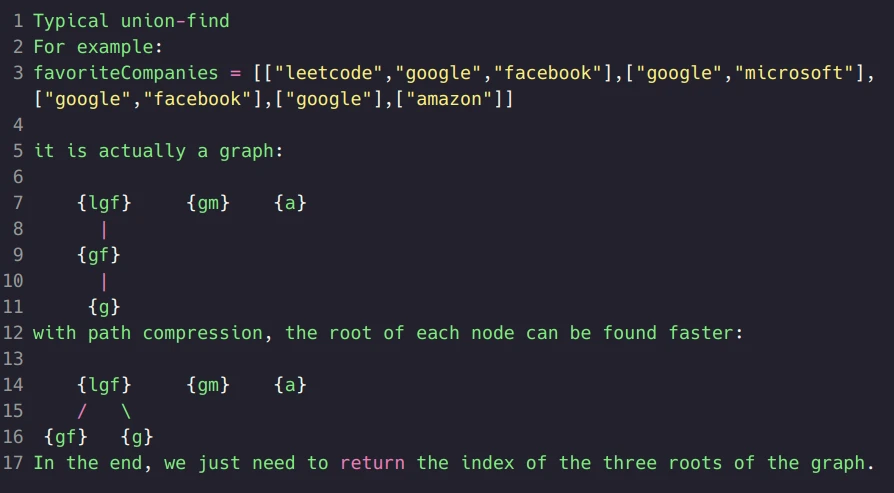
For example:
favoriteCompanies = [["leetcode","google","facebook"],["google","microsoft"],["google","facebook"],["google"],["amazon"]]It is actually a graph:
{lgf} {gm} {a} | {gf} | {g}With path compression, the root of each node can be found faster:
{lgf} {gm} {a} / \ {gf} {g}In the end, we just need to return the index of the three roots of the graph.
115. Start of LinkedList Cycle (medium)
Section titled “115. Start of LinkedList Cycle (medium)”Given the head of a Singly LinkedList that contains a cycle, write a function to find the starting node of the cycle.
Solution
Section titled “Solution”- Find the cycle length (by using slow/fast pointer) == c
- Find the first meeting point of the slow/fast pointers, then distance travelled by fast, df = 2 * ds (distance travelled by slow). So we can find the no. of nodes before the start of cycle => df =
a + c=> a =c - 2*ds. - Move a pointer from start to cover
a+1distance.
Diagram
Section titled “Diagram”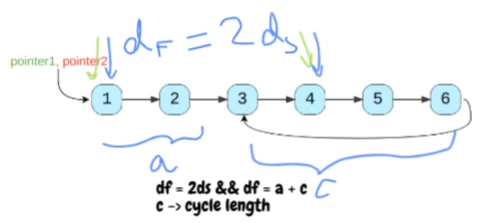
Linked list 1 -> 2 -> 3 -> 4 -> 5 -> 6, where node 6 links back to node 3 (cycle). Pointer1 and pointer2 start at node 1; the slow pointer (pointer1) and fast pointer (pointer2) meet at node 4 with dF = 2ds annotated. Bracket a spans nodes 1-2 (before the cycle); bracket c spans nodes 3-6 (the cycle). Footer: df = 2ds && df = a + c, c -> cycle length.
116. Happy Number (medium)
Section titled “116. Happy Number (medium)”Any number will be called a happy number if, after repeatedly replacing it with a number equal to the sum of the square of all of its digits, leads us to number 1. All other (not-happy) numbers will never reach 1. Instead, they will be stuck in a cycle of numbers which does not include 1.
Example
Section titled “Example”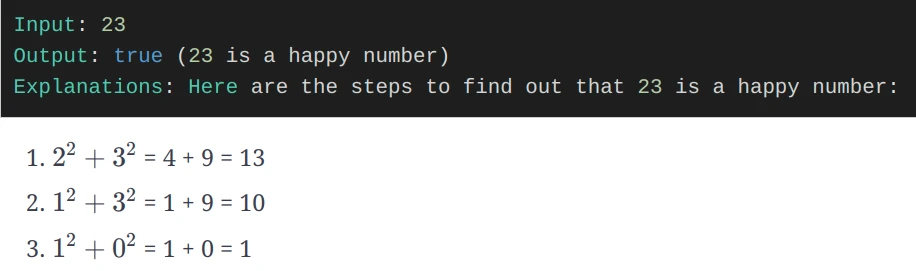
Input: 23Output: true (23 is a happy number)Explanations: Here are the steps to find out that 23 is a happy number:1. 2^2 + 3^2 = 4 + 9 = 132. 1^2 + 3^2 = 1 + 9 = 103. 1^2 + 0^2 = 1 + 0 = 1public boolean isHappyNumber(int num){ int slow = num, fast = num; do{ slow = digitSquareSum(num); fast = digitSquareSum(digitSquareSum(num)); } while(slow != fast); return slow == 1;}TC: O(logN)
Palindrome LinkedList
Section titled “Palindrome LinkedList”Given the head of a Singly LinkedList, write a method to check if the LinkedList is a palindrome or not.
As we know, a palindrome LinkedList will have nodes values that read the same backward or forward. This means that if we divide the LinkedList into two halves, the node values of the first half in the forward direction should be similar to the node values of the second half in the backward direction. As we have been given a Singly LinkedList, we can’t move in the backward direction.
- We can use the Fast & Slow pointers method similar to Middle of the
LinkedListto find the middle node of theLinkedList. - Once we have the middle of the
LinkedList, we will reverse the second half. - Then, we will compare the first half with the reversed second half to see if the
LinkedListrepresents a palindrome. - Finally, we will reverse the second half of the
LinkedListagain to revert and bring theLinkedListback to its original form.
56. Merge Intervals
Section titled “56. Merge Intervals”Given a list of intervals, merge all the overlapping intervals to produce a list that has only mutually exclusive intervals.
Example
Section titled “Example”
Intervals: [[1,4], [2,5], [7,9]]Output: [[1,5], [7,9]]Explanation: Since the first two intervals [1,4] and [2,5] overlap, we merged them into one [1,5].Diagram
Section titled “Diagram”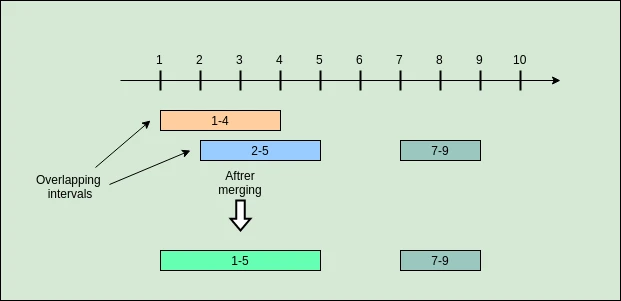
Number line 1..10. Bars: 1-4 (orange) and 2-5 (blue) are marked “Overlapping intervals” by arrows; 7-9 (grey-green) is standalone. Below, “After merging” (arrow): 1-5 (green) and 7-9 (grey-green).
Solution
Section titled “Solution”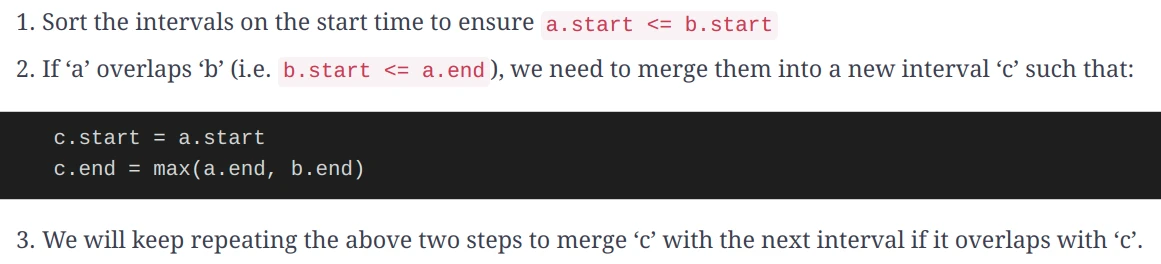
- Sort the intervals on the start time to ensure
a.start <= b.start - If
aoverlapsb(i.e.b.start <= a.end), we need to merge them into a new intervalcsuch that:
c.start = a.startc.end = max(a.end, b.end)- We will keep repeating the above two steps to merge
cwith the next interval if it overlaps withc.
public int[][] merge(int[][] intervals) { if(intervals.length == 0) return new int[0][0]; Arrays.sort(intervals, new Comparator<int[]>(){ @Override public int compare(int[] a,int[] b){ return a[0]-b[0]; } }); // initialize start and end int len = intervals.length, start = intervals[0][0], end = intervals[0][1]; // will hold final ans List<int[]> mergeIntervals = new ArrayList<>(); for(int i = 1; i < len; i++){ // if current interval start[0] is <= previous end if(intervals[i][0] <= end) end = Math.max(intervals[i][1], end); else { mergeIntervals.add(new int[]{start,end}); start = intervals[i][0]; end = intervals[i][1]; } } mergeIntervals.add(new int[]{start,end});
return mergeIntervals.toArray(new int[mergeIntervals.size()][]);}Minimum Meeting Rooms
Section titled “Minimum Meeting Rooms”Given a list of intervals representing the start and end time of N meetings, find the minimum number of rooms required to hold all the meetings.
Examples
Section titled “Examples”

Meetings: [[1,4], [2,5], [7,9]]Output: 2Explanation: Since [1,4] and [2,5] overlap, we need two rooms to hold these two meetings. [7,9] canoccur in any of the two rooms later.
Meetings: [[6,7], [2,4], [8,12]]Output: 1Explanation: None of the meetings overlap, therefore we only need one room to hold all meetings.
Timeline diagram
Section titled “Timeline diagram”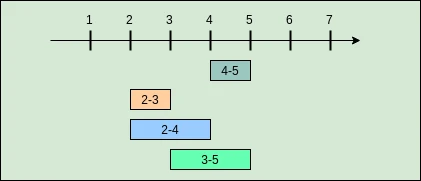
Number line 1..7 with meetings: 4-5 (grey), 2-3 (orange), 2-4 (blue), 3-5 (green).
Solution
Section titled “Solution”- Sort all the meetings on their start time.
- Create a min-heap to store all the active meetings. This min-heap will also be used to find the active meeting with the smallest end time.
- Iterate through all the meetings one by one to add them in the min-heap. Let’s say we are trying to schedule the meeting m1.
- Since the min-heap contains all the active meetings, so before scheduling m1 we can remove all meetings from the heap that have ended before m1, i.e., remove all meetings from the heap that have an end time smaller than or equal to the start time of m1.
- Now add m1 to the heap.
- The heap will always have all the overlapping meetings, so we will need rooms for all of them. Keep a counter to remember the maximum size of the heap at any time which will be the minimum number of rooms needed.
public static int findMinimumMeetingRooms(List<Meeting> meetings) { if (meetings == null || meetings.size() == 0) return 0;
// sort the meetings by start time Collections.sort(meetings, (a, b) -> Integer.compare(a.start, b.start));
int minRooms = 0; PriorityQueue<Meeting> minHeap = new PriorityQueue<>(meetings.size(), (a, b) -> Integer.compare(a.end, b.end)); for (Meeting meeting : meetings) { // remove all meetings that have ended while (!minHeap.isEmpty() && meeting.start >= minHeap.peek().end) minHeap.poll(); // add the current meeting into the minHeap minHeap.offer(meeting); // all active meeting are in the minHeap, so we need rooms for all of them. minRooms = Math.max(minRooms, minHeap.size()); } return minRooms;}Cyclic Sort
Section titled “Cyclic Sort”We are given an array containing n objects. Each object, when created, was assigned a unique number from 1 to n based on their creation sequence.
Write a function to sort the objects in-place on their creation sequence number in O(n) and without any extra space.
Examples
Section titled “Examples”

Input: [3, 1, 5, 4, 2]Output: [1, 2, 3, 4, 5]
Input: [2, 6, 4, 3, 1, 5]Output: [1, 2, 3, 4, 5, 6]
Solution
Section titled “Solution”We iterate the array one number at a time, and if the current number we are iterating is not at the correct index, we swap it with the number at its correct index. This way we will go through all numbers and place them in their correct indices, hence, sorting the whole array.
public void cyclic_sort(int[] arr){ int idx = 0; while(idx < arr.length){ if(idx == arr[idx]-1) // 1 indexed idx++; else swap(idx,arr[idx]-1); }}Find the Smallest Missing Positive Number
Section titled “Find the Smallest Missing Positive Number”Given an unsorted array containing numbers, find the smallest missing positive number in it. In this problem, the numbers are not bound by any range so we can have any number in the input array.
Example
Section titled “Example”
Input: [-3, 1, 5, 4, 2]Output: 3Explanation: The smallest missing positive number is '3'Solution
Section titled “Solution”We place the numbers on their correct indices and ignore all numbers that are out of the range of the array. Once we are done with the cyclic sort we will iterate the array and the first index that does not have the correct number will be the smallest missing positive number!
public void min_positive(int[] arr){ // 0 or 1 indexed int idx = 0; while(idx < arr.length && ){ if( arr[idx] > 0 && arr[idx] <= arr.length && arr[idx]-1 != idx) swap(idx,arr[idx]-1); else idx++; } for(int i = 0; i < arr.length; i++){ if(arr[i] != i+1) return i+1; } return nums.length+1;}437. Path Sum III
Section titled “437. Path Sum III”You are given a binary tree in which each node contains an integer value.
Find the number of paths that sum to a given value.
The path does not need to start or end at the root or a leaf, but it must go downwards (traveling only from parent nodes to child nodes).
437. Path Sum III (Count Paths for a Sum)
Section titled “437. Path Sum III (Count Paths for a Sum)”Given a binary tree and a number S, find all paths in the tree such that the sum of all the node values of each path equals S. Please note that the paths can start or end at any node but all paths must follow direction from parent to child (top to bottom).
Solution 1
Section titled “Solution 1”We can follow the same DFS approach. But there will be four differences:
- We will keep track of the current path in a list which will be passed to every recursive call.
- Whenever we traverse a node we will do two things:
- Add the current node to the current path.
- As we added a new node to the current path, we should find the sums of all sub-paths ending at the current node. If the sum of any sub-path is equal to
Swe will increment our path count.
- We will traverse all paths and will not stop processing after finding the first path.
- Remove the current node from the current path before returning from the function. This is needed to Backtrack while we are going up the recursive call stack to process other paths.
private static int countPathsRecursive(TreeNode currentNode, int S, List<Integer> currentPath) { if (currentNode == null) return 0;
// add the current node to the path currentPath.add(currentNode.val); int pathCount = 0, pathSum = 0; // find the sums of all sub-paths in the current path list ListIterator<Integer> pathIterator = currentPath.listIterator(currentPath.size()); while (pathIterator.hasPrevious()) { pathSum += pathIterator.previous(); // if the sum of any sub-path is equal to 'S' we increment our path count. if (pathSum == S) { pathCount++; } }
// traverse the left sub-tree pathCount += countPathsRecursive(currentNode.left, S, currentPath); // traverse the right sub-tree pathCount += countPathsRecursive(currentNode.right, S, currentPath);
// remove the current node from the path to backtrack, // we need to remove the current node while we are going up the recursive call stack. currentPath.remove(currentPath.size() - 1);
return pathCount;}T.C: O(N^2), S.C.: O(N)
Solution 2 (hashMap)
Section titled “Solution 2 (hashMap)”We can use the hashMap for remembering the sum values along a path.
static int count,target;static Map<Integer,Integer> map;public int pathSum(TreeNode root, int sum) { if(root==null) return 0; map = new HashMap<>(); count = 0; target = sum; map.put(0,1); prefixTree(root,null);
// System.out.println(map);
return count;}public void prefixTree(TreeNode root,TreeNode parent){ if(root == null) return;
if(parent != null) root.val += parent.val;
count += map.getOrDefault(root.val - target,0);
map.put(root.val,1 + map.getOrDefault(root.val,0));
prefixTree(root.left,root); prefixTree(root.right,root);
map.put(root.val, map.get(root.val) - 1);}public void prefixTree(TreeNode root,TreeNode parent){ if(root == null) return;
if(parent != null) root.val += parent.val;
count += map.getOrDefault(root.val - target,0);
map.put(root.val,1 + map.getOrDefault(root.val,0));
prefixTree(root.left,root); prefixTree(root.right,root);
map.put(root.val, map.get(root.val) - 1);}T.C. : O(N)
Tree Diameter
Section titled “Tree Diameter”Given a binary tree, find the length of its diameter. The diameter of a tree is the number of nodes on the longest path between any two leaf nodes. The diameter of a tree may or may not pass through the root.
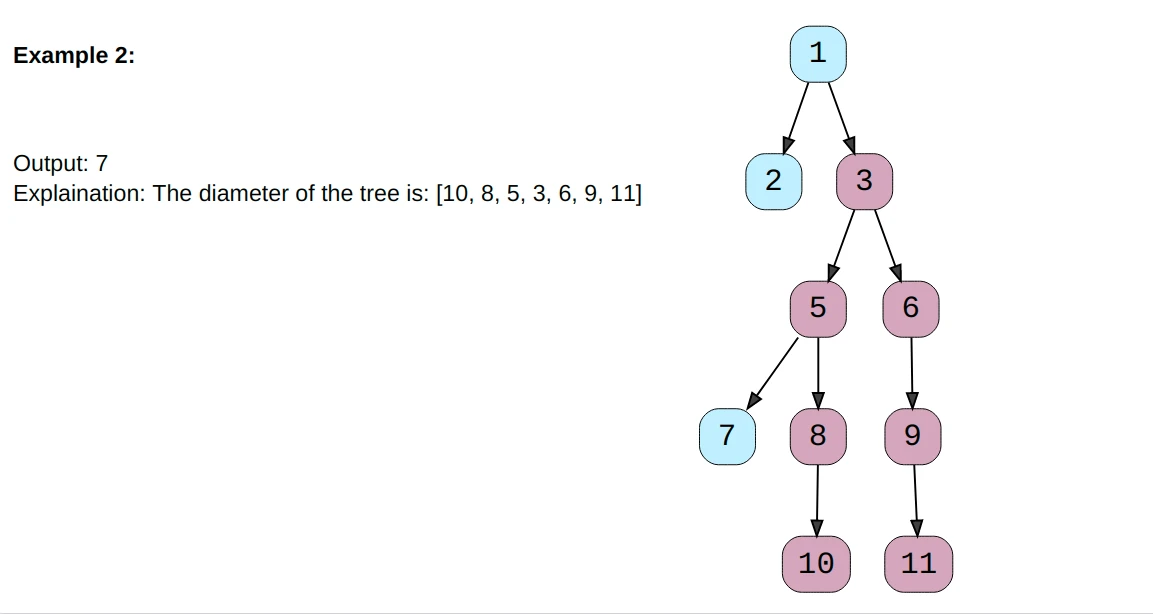
Example 2:
- Output: 7
Explaination: The diameter of the tree is: [10, 8, 5, 3, 6, 9, 11]
Tree for Example 2 (edges point parent to child):
1├── 2└── 3 ├── 5 │ ├── 7 │ └── 8 │ └── 10 └── 6 └── 9 └── 11Solution
Section titled “Solution”We can follow the same DFS approach. There will be a few differences:
- At every step, we need to find the height of both children of the current node. For this, we will make two recursive calls similar to DFS.
- The height of the current node will be equal to the maximum of the heights of its left or right children, plus ‘1’ for the current node.
- The tree diameter at the current node will be equal to the height of the left child plus the height of the right child plus ‘1’ for the current node: diameter =
leftTreeHeight+rightTreeHeight+ 1. To find the overall tree diameter, we will use a class level variable. This variable will store the maximum diameter of all the nodes visited so far, hence, eventually, it will have the final tree diameter.
public int diameterOfBinaryTree(TreeNode root) { if(root == null) return 0; int l = 0, r = 0; if(root.left != null) l = deepest(root.left) + 1; if(root.right != null) r = deepest(root.right) + 1; return max(diameterOfBinaryTree(root.left), diameterOfBinaryTree(root.right), l+r);}public int max(int a,int b,int c) { return a > b? (a > c? a: c): (b > c? b: c);}private int deepest(TreeNode root) { if(root.left == null && root.right == null) return 0; int n1 = 0, n2 = 0; if(root.left != null ) n1 = deepest(root.left)+1; if(root.right != null) n2 = deepest(root.right)+1; return Math.max(n1,n2);}We can do it in single recursion:
static int diameter;public int diameterOfBinaryTree(TreeNode root) { diameter = 0; getDepth(root); return diameter == 0?0:diameter-1;}public int getDepth(TreeNode root){ if(root == null) return 0; int lftDepth = getDepth(root.left); int rgtDepth = getDepth(root.right);
diameter = Math.max(diameter,1 +lftDepth +rgtDepth );
return 1 + Math.max(lftDepth,rgtDepth);}295. Find Median from Data Stream
Section titled “295. Find Median from Data Stream”Design a class to calculate the median of a number stream. The class should have the following two methods:
insertNum(int num): stores the number in the classfindMedian(): returns the median of all numbers inserted in the class
If the count of numbers inserted in the class is even, the median will be the average of the middle two numbers.
Example:
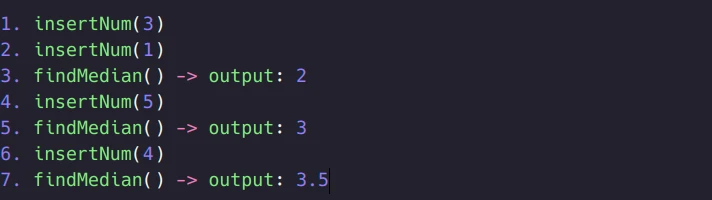
1. insertNum(3)2. insertNum(1)3. findMedian() -> output: 24. insertNum(5)5. findMedian() -> output: 36. insertNum(4)7. findMedian() -> output: 3.5Solution
Section titled “Solution”We can use two heaps maxHeap (stores smaller nos.) and minHeap (stores larger nos.). We will make sure that always size(maxHeap) >= size(minHeap). So if size(maxHeap) == size(minHeap) then median is avg(maxHeap.top, minHeap.top) otherwise, median is maxHeap.top.
For insertion there are two cases:
- If size(
maxHeap) == size(minHeap): insert the num inmaxHeapif it’s less thanmaxHeap.top, otherwise insert the num inminHeap. - If
size(maxHeap) < size(minHeap): rebalance (push theminHeap.top tomaxHeap), then this case is reduced to case 1.
PriorityQueue<Integer> maxH , minH;/** initialization of maxH and minH. */public void addNum(int n) { if(maxH.isEmpty() || n <= maxH.peek()) { maxH.add(n); // if size(maxH) - size(minH) >= 2 // case: first we insert 5, then we insert 3 if(maxH.size() - minH.size() >= 2) minH.add(maxH.poll()); } else { minH.add(n); if(minH.size() > maxH.size()) maxH.add(minH.poll()); }}
public double findMedian() { if(maxH.size() == minH.size()) return (minH.peek()+maxH.peek())/(double)2; return maxH.peek();}insertNum() will be O(logN), findMedian() will be O(1)
Subsets
Section titled “Subsets”Given a set with distinct elements, find all of its distinct subsets.
Examples:
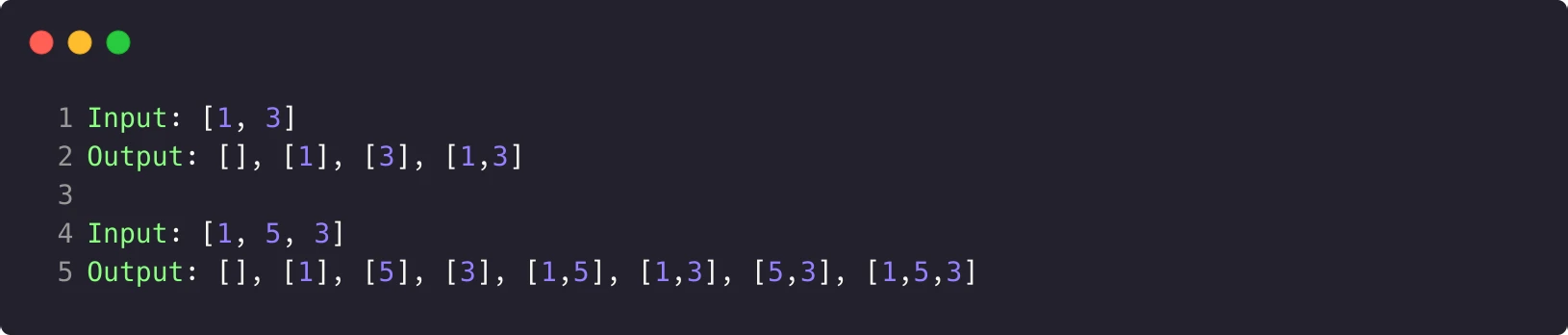
Input: [1, 3]Output: [], [1], [3], [1,3]
Input: [1, 5, 3]Output: [], [1], [5], [3], [1,5], [1,3], [5,3], [1,5,3]
Solution
Section titled “Solution”We could use bitmasks to generate solution, but it could get complicated. To generate all subsets of the given set, we can use the Breadth First Search (BFS) approach. We can start with an empty set, iterate through all numbers one-by-one, and add them to existing sets to create new subsets.
At each step our subset size doubles. So T.C. = O(2^N)
Lets go through each step of our algorithm:
Given set: [1, 5, 3]
Subset-generation diagram (copy = keep the existing subsets; add = append the number to a copy of each existing subset):
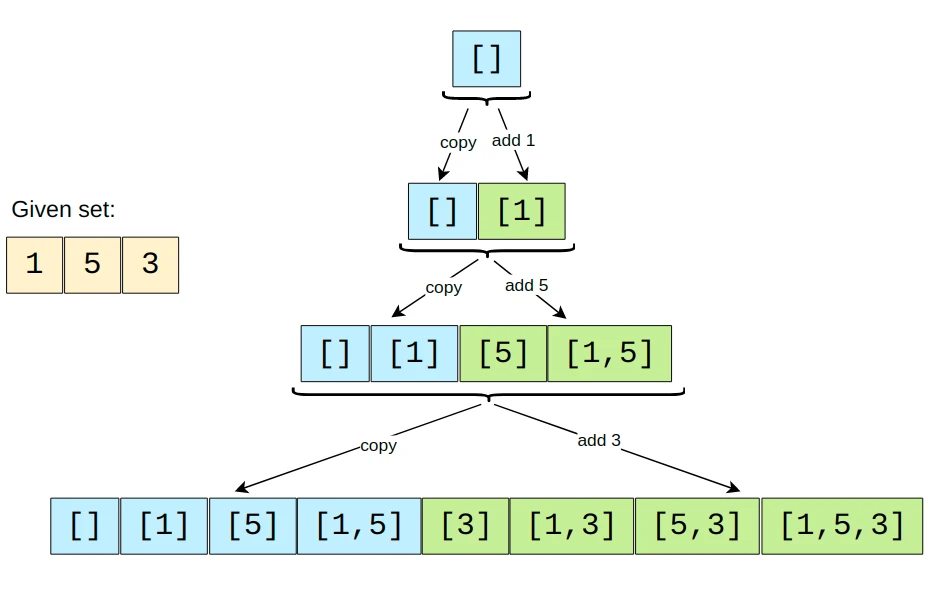
Start: []Insert 1: copy [] , add 1 -> [1] => [] [1]Insert 5: copy [] [1] , add 5 -> [5] [1,5] => [] [1] [5] [1,5]Insert 3: copy [] [1] [5] [1,5] , add 3 -> [3] [1,3] [5,3] [1,5,3]Result: [] [1] [5] [1,5] [3] [1,3] [5,3] [1,5,3]- Start with an empty set: [[]]
- Add the first number (1) to all the existing subsets to create new subsets: [[], [1]];
- Add the second number (5) to all the existing subsets: [[], [1], [5], [1,5]];
- Add the third number (3) to all the existing subsets: [[], [1], [5], [1,5], [3], [1,3], [5,3], [1,5,3]].
public List<List<Integer>> generateSubsets(int[] arr){ List<List<Integer>> subsets = new ArrayList<>(); // add an empty set subsets.add(new ArrayList<>()); for(int currentNum: arr){ int size = subsets.size(); for(int i = 0; i < size; i++){ // create a new copy of List List<Integer> newSet = new ArrayList<>(subsets.get(i)); newSet.add(currentNum); subsets.add(newSet); } } return subsets;}Subsets with duplicates
Section titled “Subsets with duplicates”Given a set of numbers that might contain duplicates, find all of its distinct subsets
Examples:

Input: [1, 3, 3]Output: [], [1], [3], [1,3], [3,3], [1,3,3]
Input: [1, 5, 3, 3]Output: [], [1], [5], [3], [1,5], [1,3], [5,3], [1,5,3], [3,3], [1,3,3], [3,3,5], [1,5,3,3]
Solution
Section titled “Solution”To handle duplicates, we will do two extra things:
- Sort all numbers of the given set. This will ensure that all duplicate numbers are next to each other.
- Follow the same BFS approach but whenever we are about to process a duplicate (i.e., when the current and the previous numbers are same), instead of adding the current number (which is a duplicate) to all the existing subsets, only add it to the subsets which were created in the previous step.
Lets go through each step of our algorithm:
Start with an empty set: [[]]
Add the first number (1) to all the existing subsets to create new subsets: [[], [1]];
Add the second number (3) to all the existing subsets: [[], [1], [3], [1,3]].
The next number (3) is a duplicate. If we add it to all existing subsets we will get:
[[], [1], [3], [1,3], [3], [1,3], [3,3], [1,3,3]]
We got two duplicate subsets: [3], [1,3]
Whereas we only needed the new subsets: [3,3], [1,3,3]
To handle this instead of adding (3) to all the existing subsets, we only add it to the new subsets which were created in the previous (3rd) step:
[[], [1], [3], [1,3], [3,3], [1,3,3]]
Finally, add the fourth number (5) to all the existing subsets: [[], [1], [3], [1,3], [3,3], [1,3,3], [5], [1,5], [3,5], [1,3,5], [3,3,5], [1,3,3,5]]

Given set: [1, 5, 3, 3]
Sorted set: [1, 3, 3, 5]
Walkthrough diagram for the sorted set [1, 3, 3, 5] (each box is one subset):
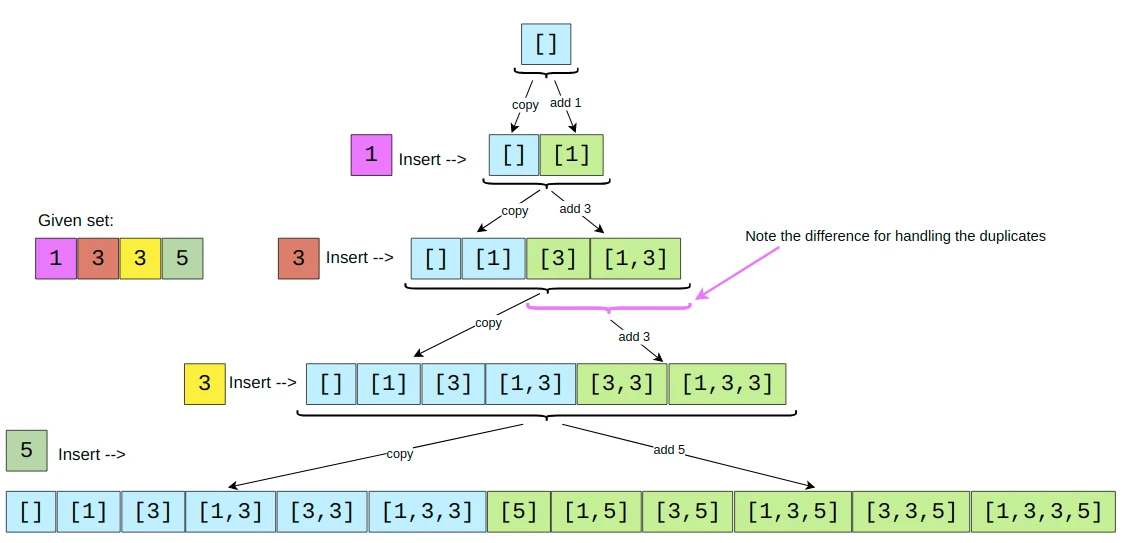
Insert 1: copy [] , add 1 -> [1] result: [] [1]Insert 3: copy [] [1] , add 3 -> [3] [1,3] result: [] [1] [3] [1,3]Insert 3 (duplicate): add 3 ONLY to the subsets created in the previous step ([3] [1,3]) -> [3,3] [1,3,3] result: [] [1] [3] [1,3] [3,3] [1,3,3]Insert 5: copy all , add 5 -> [5] [1,5] [3,5] [1,3,5] [3,3,5] [1,3,3,5] result: [] [1] [3] [1,3] [3,3] [1,3,3] [5] [1,5] [3,5] [1,3,5] [3,3,5] [1,3,3,5]The source diagram marks the duplicate step with the note: “Note the difference for handling the duplicates”.
public List<List<Integer>> generateSubsets(int[] arr){ // sort the array Arrays.sort(arr) List<List<Integer>> subsets = new ArrayList<>(); // add an empty set subsets.add(new ArrayList<>()); int startIndex = 0, endIndex = 0; for(int i = 0; i < arr.length; i++){ int currentNum = arr[i]; startIndex = 0; if(i > 0 && arr[i] == arr[i-1]) // duplicate found startIndex = endIndex + 1; endIndex = subsets.size()-1; for(int i = startIndex; i <= endIndex; i++){ // create a new copy of List List<Integer> newSet = new ArrayList<>(subsets.get(i)); newSet.add(currentNum); subsets.add(newSet); } } return subsets;}Permutations
Section titled “Permutations”Given a set of distinct numbers, find all of its permutations.
Examples:

Input: [1,3,5]Output: [1,3,5], [1,5,3], [3,1,5], [3,5,1], [5,1,3], [5,3,1]Solution
Section titled “Solution”Following a BFS approach, we will consider one number at a time:
- If the given set is empty then we have only an empty permutation set: []
- Let’s add the first element (1), the permutations will be: [1]
- Let’s add the second element (3), the permutations will be: [3,1], [1,3]
- Let’s add the third element (5), the permutations will be: [5,3,1], [3,5,1], [3,1,5], [5,1,3], [1,5,3], [1,3,5]
Permutation diagram:
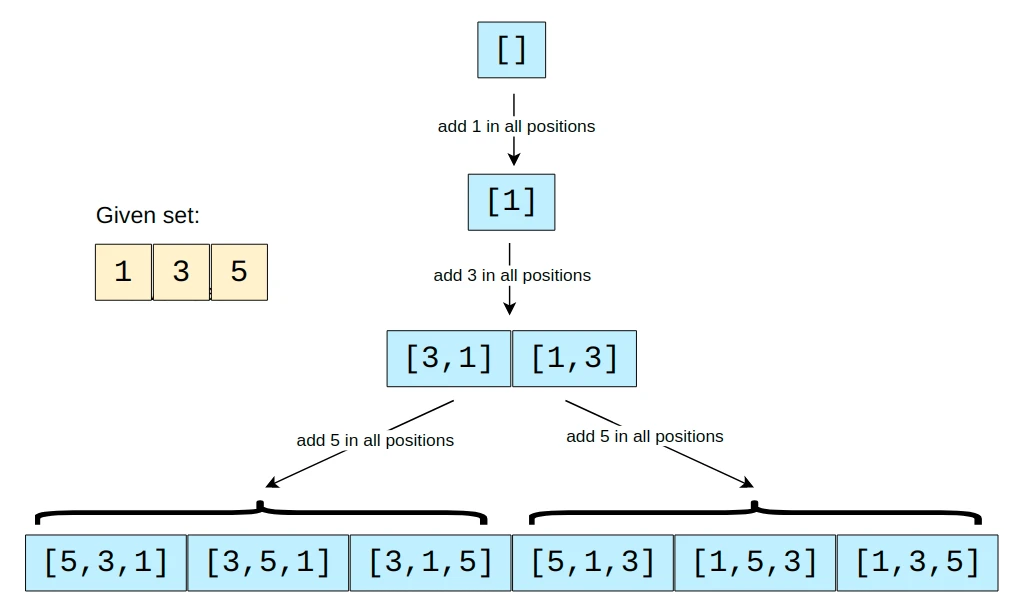
Given set: 1 3 5
[] |-- add 1 in all positions -> [1] |-- add 3 in all positions -> [3,1]  [1,3] |-- add 5 in all positions:       on [3,1] -> [5,3,1]  [3,5,1]  [3,1,5]       on [1,3] -> [5,1,3]  [1,5,3]  [1,3,5]
So approach is like : for each list in previous step, we insert the current number to every possible index and add it to the step.
public static List<List<Integer>> findPermutations(int[] nums) { List<List<Integer>> result = new ArrayList<>(); Queue<List<Integer>> permutations = new LinkedList<>(); permutations.add(new ArrayList<>()); for (int currentNumber : nums) { // we will take all existing permutations and add the current number to create new permutations int n = permutations.size(); for (int i = 0; i < n; i++) { List<Integer> oldPermutation = permutations.poll(); // create a new permutation by adding the current number at every position for (int j = 0; j <= oldPermutation.size(); j++) { List<Integer> newPermutation = new ArrayList<Integer>(oldPermutation); newPermutation.add(j, currentNumber); if (newPermutation.size() == nums.length) result.add(newPermutation); else permutations.add(newPermutation); } } } return result;}Balanced Parentheses
Section titled “Balanced Parentheses”Given a set of distinct numbers, find all of its permutations.
Note: the problem statement above is reproduced as it appears in the source PDF text (it describes the permutations problem, not balanced parentheses).
Examples:

Input: N=2Output: (()), ()()
Input: N=3Output: ((())), (()()), (())(), ()(()), ()()()
Solution
Section titled “Solution”Parentheses generation diagram: each level shows the partial strings after adding one character (add ( or )), keeping only valid prefixes. Level 1 is the empty string root, and the diagram’s branch labels are “add ’(’” and “add ’)’”:
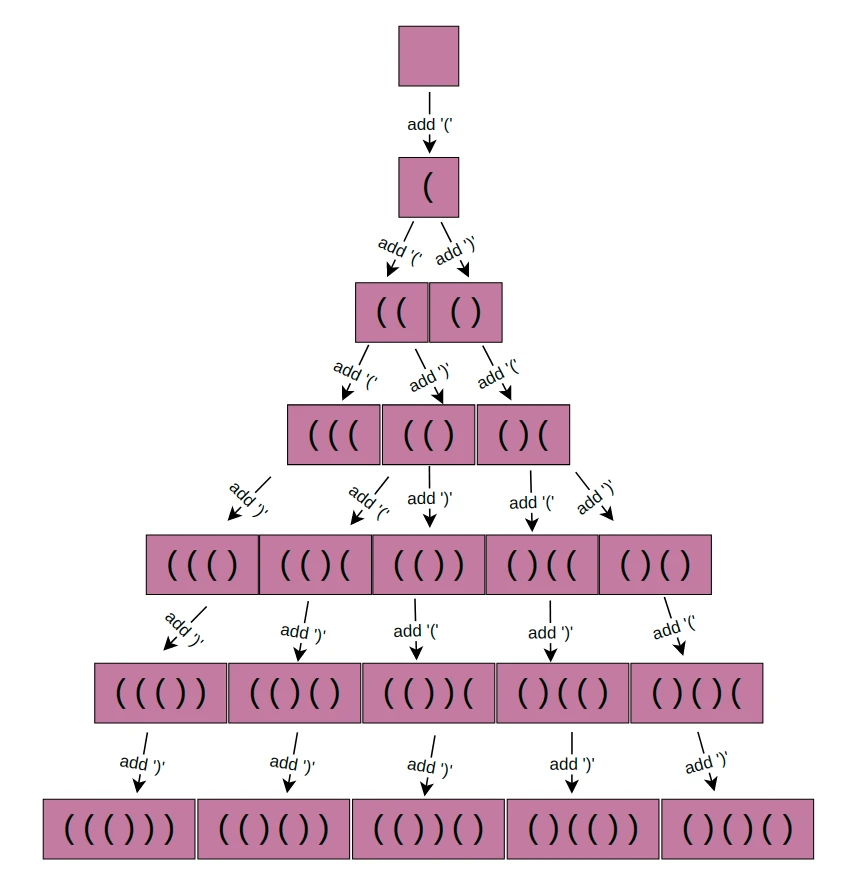
Level 0: ""Level 1: (Level 2: (( ()Level 3: ((( (() ()(Level 4: ((() (()( (()) ()() ()((Level 5: ((()) (()() (())( ()()( ()(()Level 6: ((())) (()()) (())() ()()() ()(())public static List<String> generateValidParentheses(int num) { List<String> result = new ArrayList<String>(); Queue<ParenthesesString> queue = new LinkedList<>(); queue.add(new ParenthesesString("", 0, 0)); while (!queue.isEmpty()) { ParenthesesString ps = queue.poll(); // if we've reached the maximum number of open and close parentheses, add to the result if (ps.openCount == num && ps.closeCount == num) { result.add(ps.str); } else { // if we can add an open parentheses, add it if (ps.openCount < num) queue.add(new ParenthesesString(ps.str + "(", ps.openCount + 1, ps.closeCount));
// if we can add a close parentheses, add it if (ps.openCount > ps.closeCount) queue.add(new ParenthesesString(ps.str + ")", ps.openCount, ps.closeCount + 1)); } } return result;}Two Single Numbers
Section titled “Two Single Numbers”In a non-empty array of numbers, every number appears exactly twice except two numbers that appear only once. Find the two numbers that appear only once.
Solution
Section titled “Solution”Let’s assume num1 and num2 are the two single numbers. If we do XOR of all elements of the given array, we will be left with XOR of num1 and num2 as all other numbers will cancel each other because all of them appeared twice. Let’s call this XOR n1xn2.
Now, any set bit in n1xn2 represents that num1 & num2 have different bit at that position. Thus, we can use any set bit in n1xn2 (let’s call it B) and divide the array into two subsets, one set with bit at location B as 1 and other set will have it as 0.
public int[] two_single(int[] A){ int n1xn2 = 0; for(int i = 0; i < A.length; i++) n1xn2 ^= A[i]; int rightMostSetBit = n1xn2&(~( n1xn2&(n1xn2-1) )); int num1 = 0, num2 = 0; for(int i = 0; i < A.length; i++){ if(rightMostSetBit & A[i] == 0) num1 ^= A[i]; else num2 ^= A[i]; } return new int[]{num1,num2};}Tasks Scheduling
Section titled “Tasks Scheduling”There are ‘N’ tasks, labeled from ‘0’ to ‘N-1’. Each task can have some prerequisite tasks which need to be completed before it can be scheduled. Given the number of tasks and a list of prerequisite pairs, find out if it is possible to schedule all the tasks.
Examples:


Input: Tasks=6, Prerequisites=[2, 5], [0, 5], [0, 4], [1, 4], [3, 2], [1, 3]Output: trueExplanation: A possible sceduling of tasks is: [0 1 4 3 2 5]
Input: Tasks=3, Prerequisites=[0, 1], [1, 2], [2, 0]Output: []Explanation: The tasks have cyclic dependency, therefore they cannot be scheduled.// graph here represents the tasks graphpublic List<Integer> topo_sort(HashMap<Integer, List<Integer>> graph, HashMap<Integer, Integer> indegree){ Queue<Integer> q = new LinkedList<>(); for(Map.Entry<Integer,Integer> entry: indegree.entrySet()) if(entry.getValue() == 0) q.add(entry.getKey()); List<Integer> topo = new ArrayList<>(); while(!q.isEmpty()){ int u = q.poll(); topo.add(u); for(Integer v: graph.get(u)){ // for all the child nodes indegree.put(v,indegree.get(v) -1); if(indegree.get(v) == 0) q.add(v); } } // if topological sort includes all the vertices then there is // no cyclic dependencies. return topo.size() == graph.size();}Rearrange String
Section titled “Rearrange String”Given a string, find if its letters can be rearranged in such a way that no two same characters come next to each other.
Examples:

Input: "aappp"Output: "papap"Explanation: In "papap", none of the repeating characters come next to each other.Solution
Section titled “Solution”The first thing is we need to place the characters as far as possible, this is possible when we place the most frequently occurring characters first. So in each step we place the most frequent character in the current place. To track the frequency we use a hashmap, then to track the most freq. char. we use the Max Heap.
We pop an element from this Max Heap, then append to answer string then decrement it’s frequency. Since two characters cannot be adjacently placed, We will not put this character back in the heap to ensure that no two same characters are adjacent to each other.
In the next step, we should process the next most frequent character from the heap in the same way and then, at the end of this step, insert the character from the previous step back to the heap after decrementing its frequency.
public static String rearrangeString(String str) { Map<Character, Integer> charFrequencyMap = new HashMap<>(); for (char chr : str.toCharArray()) charFrequencyMap.put(chr, charFrequencyMap.getOrDefault(chr, 0) + 1);
PriorityQueue<Map.Entry<Character, Integer>> maxHeap = new PriorityQueue<Map.Entry<Character, Integer>>( (e1, e2) -> e2.getValue() - e1.getValue());
// add all characters to the max heap maxHeap.addAll(charFrequencyMap.entrySet());
Map.Entry<Character, Integer> previousEntry = null; StringBuilder resultString = new StringBuilder(str.length()); while (!maxHeap.isEmpty()) { Map.Entry<Character, Integer> currentEntry = maxHeap.poll(); // add the previous entry back in the heap if its frequency is greater than zero if (previousEntry != null && previousEntry.getValue() > 0) maxHeap.offer(previousEntry); // append the current character to the result string and decrement its count resultString.append(currentEntry.getKey()); currentEntry.setValue(currentEntry.getValue() - 1); previousEntry = currentEntry; }
// if we were successful in appending all the characters to the result string, return it return resultString.length() == str.length() ? resultString.toString() : "";}Number of Sub-arrays With Odd Sum
Section titled “Number of Sub-arrays With Odd Sum”Given an array of integers arr. Return the number of sub-arrays with odd sum.
As the answer may grow large, the answer must be computed modulo 10^9 + 7.
Examples:


Input: arr = [1,3,5]Output: 4Explanation: All sub-arrays are [[1],[1,3],[1,3,5],[3],[3,5],[5]]All sub-arrays sum are [1,4,9,3,8,5].Odd sums are [1,9,3,5] so the answer is 4.
Input: arr = [100,100,99,99]Output: 4static int MOD = (int)(1e9+7);public int numOfSubarrays(int[] arr) { long o = 0, e = 0, ans = 0; // in each iteration we keep track of no. of subarrays ending at index == i which can have // even sum, as well as we do same for odd sum. for(int i = 0; i < arr.length; i++){ if(arr[i] % 2 == 1){ long tmp = o; o = e + 1; e = tmp; } else if(arr[i] %2 == 0) e = e + 1; ans = (ans+o)%MOD; } return (int)ans;}1526. Minimum Number of Increments on Subarrays to Form a Target Array
Section titled “1526. Minimum Number of Increments on Subarrays to Form a Target Array”Given an array of positive integers target and an array initial of same size with all zeros.
Return the minimum number of operations to form a target array from initial if you are allowed to do the following operation:
- Choose any subarray from initial and increment each value by one.
The answer is guaranteed to fit within the range of a 32-bit signed integer.
Examples:

Input: target = [1,2,3,2,1]Output: 3Explanation: We need at least 3 operations to form the target array from the initial array.[0,0,0,0,0] increment 1 from index 0 to 4 (inclusive).[1,1,1,1,1] increment 1 from index 1 to 3 (inclusive).[1,2,2,2,1] increment 1 at index 2.[1,2,3,2,1] target array is formed.Ugly numbers
Section titled “Ugly numbers”Given three prime numbers A, B and C and an integer D.
You need to find the first (smallest) D integers which only have A, B, C or a combination of them as their prime factors.
Eg. for A = 2, B = 3, C = 5, D = 5 output => [2, 3, 4, 5, 6]
public int minNumberOperations(int[] target) { // difference array int[] D = new int[target.length]; int ans = target[0]; D[0] = target[0]; for(int i = 1; i < target.length; i++){ D[i] = target[i] - target[i-1]; // if the value of difference array is positive then we need to // add that extra amount to form the value : target[i], if it is // negative then we would have added till i-1, so we ignore it if(D[i] > 0) ans += D[i]; } return ans;}public int[] solve(int A, int B, int C, int D) { int[] dp = new int[D+1]; int[] ans = new int[D]; // just for returning in correct form dp[0] = 1; int t1 = 0, t2 = 0, t3 = 0; // all pointing to idx==0 for(int i = 1; i <= D; i++){ /* finding next term from previously found terms */ dp[i] = Math.min(A*dp[t1], Math.min(B*dp[t2], C*dp[t3])); ans[i-1] = dp[i]; if(dp[i] == A*dp[t1]) t1++; if(dp[i] == B*dp[t2]) t2++; // avoiding duplicates if(dp[i] == C*dp[t3]) t3++; } return ans; // it should not have dp[0] so we create ans[]}Longest Arithmetic Subsequence
Section titled “Longest Arithmetic Subsequence”Given an Array of numbers find the longest Arithmetic sequence.
Usually the constraints are weak for this problem.
Eg. A = [ 9, 4, 2, 7, 10 ]
- Output: 3 as [ 4, 7, 10 ] is aritmetic sequence with
difference == 3
Solution
Section titled “Solution”Similar to Longest Increasing subsequence
public static int longestArithSeqLength(int[] A) { if(A.length == 0) return 0; Map<Integer,Integer>[] map = new HashMap[A.length]; int mx = 1; for(int i = 0; i < A.length; i++){ map[i] = new HashMap<>(); for(int j = 0; j < i; j++){ // let diff == A[i] - A[j] // currLen denotes if we already have diff int currLen = map[i].getOrDefault(A[i]-A[j], 0); // prevLen denotes in map[j] , if diff is present int prevLen = map[j].getOrDefault(A[i]-A[j], 1); if(prevLen+1 > currLen){ map[i].put(A[i]-A[j], prevLen + 1); } mx = Math.max(mx, map[i].get(A[i]-A[j])); } } return mx;}We can also do another thing, we find the maximum difference possible.
public static int longestArithSeqLength(int[] A) { int mx = Integer.MIN_VALUE, mn = Integer.MAX_VALUE; for (int i = 0; i < A.length; i++) { mx = mx > A[i]? mx: A[i]; mn = mn < A[i]? mn: A[i]; } int t = mx-mn; // maximum difference possible // any diff will be : -t <= diff <= t, so we declare 2d array int[][] dp = new int[A.length][(t<<1)+1]; for (int i = 0; i < dp.length; i++) Arrays.fill(dp[i],1);
int ans = 0; for (int i = 1; i < A.length; i++) { for (int j = 0; j < i; j++) { int diff = A[i]-A[j]; dp[i][t+diff] = dp[j][t+diff] + 1; ans = Math.max(dp[i][t+diff], ans); } } return ans;}A = [1, 2, 1, 2]output: 2
A = [7, 2, 4, 8, 7]output: 6Best Time to Buy and Sell Stocks III
Section titled “Best Time to Buy and Sell Stocks III”Given an array A, for which the ith element is the price of a given stock on day i.
Design an algorithm to find the maximum profit. You may complete at most 2 transactions.
Explanation
Section titled “Explanation”In order to sell the stock, you must’ve bought it on a day t=[0..j-1].
Maximum profit that can be attained is t:0->j-1
max(prices[j]-prices[t]+dp[i-1][t-1]) where prices[j]-prices[t] is the profit from buying on day t and selling on day j. dp[i-1][t-1] is the maximum profit that can be made with at most i-1 transactions with prices prices[0..t-1].
In order to reduce it to O(nk), we must find t:0->j-1 max(prices[j]-prices[t]+dp[i-1][t-1]) this expression in constant time. If you see carefully,
t:0->j-1 max(prices[j]-prices[t]+dp[i-1][t-1]) is same as
prices[j] + t:0->j-1 max(dp[i-1][t-1]-prices[t])
Second part of the above expression maxTemp = t:0->j-1 max(dp[i-1][t-1]-prices[t]) can be included in the dp loop by keeping track of the maximum value till j-1.
public int maxProfit(final int[] A) { int n = A.length; int[][] dp = new int[2][n]; if(n == 0) return 0; int lmin = A[0]; for(int i = 1; i < n; i++){ lmin = Math.min(lmin, A[i]); dp[0][i] = Math.max(dp[0][i-1], A[i] - lmin); }
int tmpMax = -1*A[0]; for(int i = 1; i < n; i++){ dp[1][i] = Math.max(A[i] + tmpMax, dp[1][i-1]); tmpMax = Math.max(tmpMax, dp[0][i] - A[i]);
/////////////////////////////////////////////////// //lmin = A[i]; //for(int j = i-1; j >= 0; j--){ // lmin = Math.min(A[j], lmin); // dp[1][i] = Math.max(A[i] - lmin + (j>0?dp[0][j-1]:0), dp[1][i]); //} //dp[1][i] = Math.max(dp[1][i], dp[1][i-1]); /////////////////////////////////////////////////// } return dp[1][n-1];}Longest valid Parentheses
Section titled “Longest valid Parentheses”Given a string A containing just the characters ’(’ and ’)’.
Find the length of the longest valid (well-formed) substring of parentheses.
For, A = ”)()())” Output = 4
For A = ”())()” Output = 2
public int longestValidParentheses(String s) { int l = 0, r = 0, ans = 0, c = 0; char[] ss = s.toCharArray(); int[] dp = new int[ss.length]; for (int i = 0; i < s.length(); i++) { if(ss[i] == '(') dp[i] = 0; else if(i > 0){ if(ss[i-1] == '(') dp[i] = i > 1?dp[i-2]+2:2; else if(i-dp[i-1] > 0 && ss[i-dp[i-1]-1] == '(') dp[i] = i-dp[i-1] > 1? dp[i-dp[i-1]-2]+dp[i-1]+2: dp[i-1]+2; } ans = ans < dp[i]? dp[i]:ans; } return ans;}Sub Matrices with sum Zero
Section titled “Sub Matrices with sum Zero”Given a 2D matrix, find the number non-empty sub matrices, such that the sum of the elements inside the sub matrix is equal to 0. (note: elements might be negative).
Eg.
-8 5 7 3 7 -8 5 -8 9- Output: 2
Explanation
Section titled “Explanation”The approach is like, we create a new matrix dp[][], where dp[i][j] == sum of all elements of the matrix whose bottom-right corner is (i,j). Then for each element in the matrix we find all the submatrices, but instead of this we find all the submatrices where any element (i,j) is the bottom-right (or any other) corner element.
public int solve(ArrayList<ArrayList<Integer>> A) { int m = A.size(); if(m == 0) return 0; int n = A.get(0).size(); int[][] dp = new int[m][n]; int count = 0;
for(int i = 0; i < m; i++){ for(int j = 0; j < n; j++){ dp[i][j] = A.get(i).get(j); if(i != 0) dp[i][j] += dp[i-1][j]; if(j != 0) dp[i][j] += dp[i][j-1]; if(i!=0 && j!=0) dp[i][j] -= dp[i-1][j-1];
for(int i1 = 0; i1 <= i; i1++) for(int j1 = 0; j1 <= j; j1++) if(area(i1,j1,i,j,dp) == 0) count++; } }
return count;}public int area(int x,int y, int m, int n, int[][] dp){ int a = dp[m][n];
if(x != 0) a -= dp[x-1][n]; if(y != 0) a -= dp[m][y-1]; if(x != 0 && y != 0) a += dp[x-1][y-1]; return a;}741. Cherry Pickup
Section titled “741. Cherry Pickup”In a N x N grid representing a field of cherries, each cell is one of three possible integers.
- 0 means the cell is empty, so you can pass through;
- 1 means the cell contains a cherry, that you can pick up and pass through;
- -1 means the cell contains a thorn that blocks your way.
Your task is to collect maximum number of cherries
Similar : 1463. Cherry Pickup II
- Input: grid =
[[0, 1, -1], [1, 0, -1], [1, 1, 1]]- Output: 5
static int[][][][] dp;public int cherryPickup(int[][] grid) { // 0 -> cell is empty // 1 -> cherry //-1 -> blocked int n = grid.length; dp = new int[n][n][n][n]; return Math.max(0,twoRobot(0,0,0,0,grid));}public int twoRobot(int r1,int c1, int r2, int c2, int[][] grid){ if(r1 >= grid.length || r2 >= grid.length || c1 >= grid[0].length || c2 >= grid[0].length || grid[r1][c1] == -1 || grid[r2][c2] == -1) return Integer.MIN_VALUE; if(dp[r1][c1][r2][c2] != 0) return dp[r1][c1][r2][c2]; int cherry = 0, n = grid.length;
// if person 1 reached the bottom right, return what's in there (could be 1 or 0) if(r1 == n - 1 && c1 == n - 1) return grid[r1][c1];
// if person 2 reached the bottom right, return what's in there (could be 1 or 0) if(r2 == n - 1 && c2 == n - 1) return grid[r2][c2];
if(r1 == r2 && c1 == c2) cherry += grid[r1][c1]; else cherry += grid[r1][c1] + grid[r2][c2];
cherry += max4( twoRobot(r1+1,c1, r2+1,c2,grid) // down down , twoRobot(r1,c1+1, r2,c2+1,grid) // right right , twoRobot(r1+1,c1, r2, c2+1,grid) // down right , twoRobot(r1,c1+1, r2+1,c2,grid) // right down );
dp[r1][c1][r2][c2] = cherry; return cherry;}public int max4(int a,int b,int c,int d){ return Math.max(Math.max(Math.max(a,b),c),d);}1368. Minimum Cost to Make at Least One Valid Path in a Grid
Section titled “1368. Minimum Cost to Make at Least One Valid Path in a Grid”Given a m x n grid. Each cell of the grid has a sign pointing to the next cell you should visit if you are currently in this cell. The sign of grid[i][j] can be:
- 1 which means go to the cell to the right. (i.e go from
grid[i][j]togrid[i][j + 1]) - 2 which means go to the cell to the left. (i.e go from
grid[i][j]togrid[i][j - 1]) - 3 which means go to the lower cell. (i.e go from
grid[i][j]togrid[i + 1][j]) - 4 which means go to the upper cell. (i.e go from
grid[i][j]togrid[i - 1][j])
A valid path in the grid is a path which starts from the upper left cell (0,0) and ends at the bottom-right cell (m - 1, n - 1) following the signs on the grid. The valid path doesn’t have to be the shortest.
You can modify the sign on a cell with cost = 1. You can modify the sign on a cell one time only.
Return the minimum cost to make the grid have at least one valid path.
Example grid 1 (4 x 4, image; arrows as drawn, colors as in the figure, no caption):
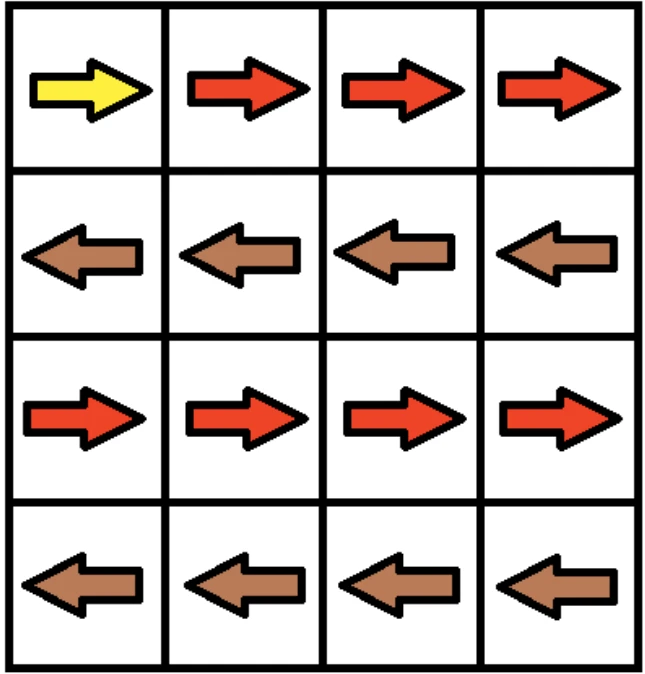
| Row | Col 1 | Col 2 | Col 3 | Col 4 |
|---|---|---|---|---|
| 1 | yellow → (start cell (0,0)) | red → | red → | red → |
| 2 | brown ← | brown ← | brown ← | brown ← |
| 3 | red → | red → | red → | red → |
| 4 | brown ← | brown ← | brown ← | brown ← |
Example grid 2 (3 x 3, image; arrows as drawn, colors as in the figure, no caption):
| Row | Col 1 | Col 2 | Col 3 |
|---|---|---|---|
| 1 | yellow → (start cell (0,0)) | red → | blue ↓ |
| 2 | blue ↓ | brown ← | brown ← |
| 3 | red → | red → | pink ↑ |
Solution
Section titled “Solution”This problem is very tricky!. It can be solved using DFS, but it would result in TLE. Then, next thing to use is Dijkstra. The approach is VlogE, this can be optimised using 0-1 BFS to V (or O(MN)).
NOTE: The Dijkstra algorithm in previous post was not working, I’ve to remove the line if(visited[x][y]) continue; Don’t know why it wasn’t working.
static int INF = (int)1e9;static int[][] dir = {{0,1},{0,-1},{1,0},{-1,0}};public int minCost(int[][] grid) { int n = grid.length, m = grid[0].length; int[][] dist = new int[n][m]; boolean[][] visited = new boolean[n][m]; for(int i = 0; i < n; i++) Arrays.fill(dist[i], INF); dist[0][0] = 0; // Dijkstra // PriorityQueue<int[]> q = new PriorityQueue<>(new Comparator<>(){ // @Override // public int compare(int[] a,int[] b){ // return dist[a[0]][a[1]]-dist[b[0]][b[1]]; // } // }); // 0-1 BFS Deque<int[]> q = new ArrayDeque<>(); q.add(new int[]{0,0}); while(!q.isEmpty()){ int[] pop = q.removeFirst(); int x = pop[0], y = pop[1]; visited[x][y] = true; int cd = grid[x][y]-1; for(int i = 0; i < 4; i++){ int nx = x + dir[i][0], ny = y + dir[i][1]; if(nx < 0 || ny < 0 || nx >= n || ny >= m) continue; int w = (cd==i?0:1); if(dist[nx][ny] > dist[x][y]+w){ dist[nx][ny] = dist[x][y]+w; if(w == 0) q.addFirst(new int[]{nx,ny}); else q.addLast(new int[]{nx,ny}); } } } return dist[n-1][m-1];}1124. Longest Well-Performing Interval
Section titled “1124. Longest Well-Performing Interval”Given an array find the longest subarray positive (>0) sum subarray containing 1 and -1 only.
Eg. -1 -1 -1 1 1 -1 -1 -1 1 1 1
- Output: 9
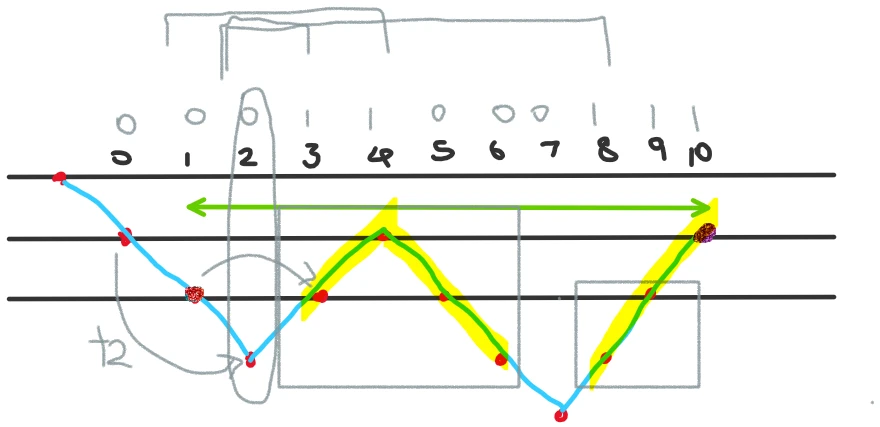
Sketch (hand-drawn, image): a price-like line plotted over indices 0 to 10 on the x-axis (numbers 0-10 written above the axis, three horizontal guide lines), with red dots on points, yellow highlighted segments on the rising/falling runs (roughly indices 3-4 and 4-6 and 8-10), a green double-headed arrow spanning index 1 to index 10 along the top, a grey oval/loop around index 2, a grey curved arrow labelled t2 from index 0 to index 2, and two grey rectangles around the segments between 4-7 and 7-9. Text is hand-drawn and not otherwise labelled.
Yellow portions are useless, as once we reached a sum state for the first time, we will store it in Map. Then if incase the sum till now is positive, then I update the answer to i+1. Otherwise, if we reached this sum for the first time we store it in map, then check if we have reached the sum of (sum-1) earlier coz, the sum from prev (sum-1) till i will be 1 (excluding the sum-1) as sum - (sum-1) == 1.
for(int i = 0; i < n; i++){ s+= A[i]; if(s > 0) ans = i+1; else{ map.putIfAbsent( s, i); if(map.containsKey(s-1)) ans = Math.max(ans, i - map.get(s-1)); }}Generalized Problem: Find Longest Subarray With Sum >= K
Section titled “Generalized Problem: Find Longest Subarray With Sum >= K”- Input: array arr in which elements are arbitrary integers.
- Output: length of a longest subarray arr[i, j) with sum(
arr[i], … ,arr[j-1]) >= K.
- Compute prefix sum of arr as
prefixSumwhereprefixSum[i]= sum(arr[0], …arr[i-1]) for i > 0 andprefixSum[0]= 0. - Iterate through
prefixSumfrom begin to end and build a strictly monotone decreasing stacksmdStack. (smdStack.top()is the smallest) - Iterate through
prefixSumfrom end to begin. For eachprefixSum[i], whilesmdStack.top()is less thanprefixSum[i]by at least K, popsmdStackand try to update result by subarray [index of top,i). Until top element is not less than it by K. - Return result.
For simplicity, call (i, j) a valid pair if the inequation prefixSum[j] - prefixSum[i] >= K holds. Our goal is to optimize j-i over all valid pair (i, j).
- Firstly, fix j and minimize i. Consider any i1 and i2 that
i1 < i2< j andprefixSum[i1]<=prefixSum[i2]. It is obvious that(i2, j)can’t be a candidate of optimal subarray because(i1, j)is more promising to be valid and longer than(i2, j). Therefor candidates are monotone decreasing, and we can use a strictly monotonic descresing stack to find all candidates. (Monotone stack are just normal stack with a constraint that the elements in them are monotonically increasing or decreasing. When processing a new element, we either pop top elements then push new elem or discard this new element to guarantee the property of monotonicity. If you are not familiar with this data structure, you’d better solve some similar leetcode problems before this one). - Secondly, fix i and maximize j. Consider any j1 and j2 that
i < j1< j2 andprefixSum[j2]-prefix[i]>= K. We can find that(i, j1)can’t be a candidate of optimal subarrary because(i, j2)is better. This discovery tells us that we should iterate j from end to begin and if we find a valid(i, j), we don’t need to keep i insmdStackany longer.
31. Next Permutation
Section titled “31. Next Permutation”Implement next permutation, which rearranges numbers into the lexicographically next greater permutation of numbers.
- Input: nums = [3,2,1]
- Output: [1,2,3]

Swap example (image): array 1 2 5 4 [8 7 6 3]-style sketch, i.e. before: 1 2 5 4 | 8 7 6 3, where the swap pairs 4 with 6 (“Swap as 6>4 and 6 is closest to 4”), giving 1 2 5 6 | 3 4 7 8 after the sort of the suffix (“after swap sort” label).
public static void nextPerm(int[] A){ int N = A.length; int idx = N-2; for(;idx>=0; idx--){ if(A[idx] < A[idx+1]) break; } if(idx>=0){ int cur = A[idx], dist = (int)1e9, mn = -1; for(int i = idx+1; i < N; i++){ if(dist > A[i]-cur && A[i] > cur){ dist = A[i]-cur; mn = i; } } int t = A[idx]; A[idx] = A[mn]; A[mn] = t; } Arrays.sort(A, idx+1, N);}Important Links
Section titled “Important Links”12 Week Programme - Leetcode
Tech Interview Handbook
Mock Interview:
Parking Lot OOD:
- https://www.youtube.com/watch?v=tVRyb4HaHgw (Better)
- https://www.youtube.com/watch?v=DSGsa0pu8-k (If have more time)